
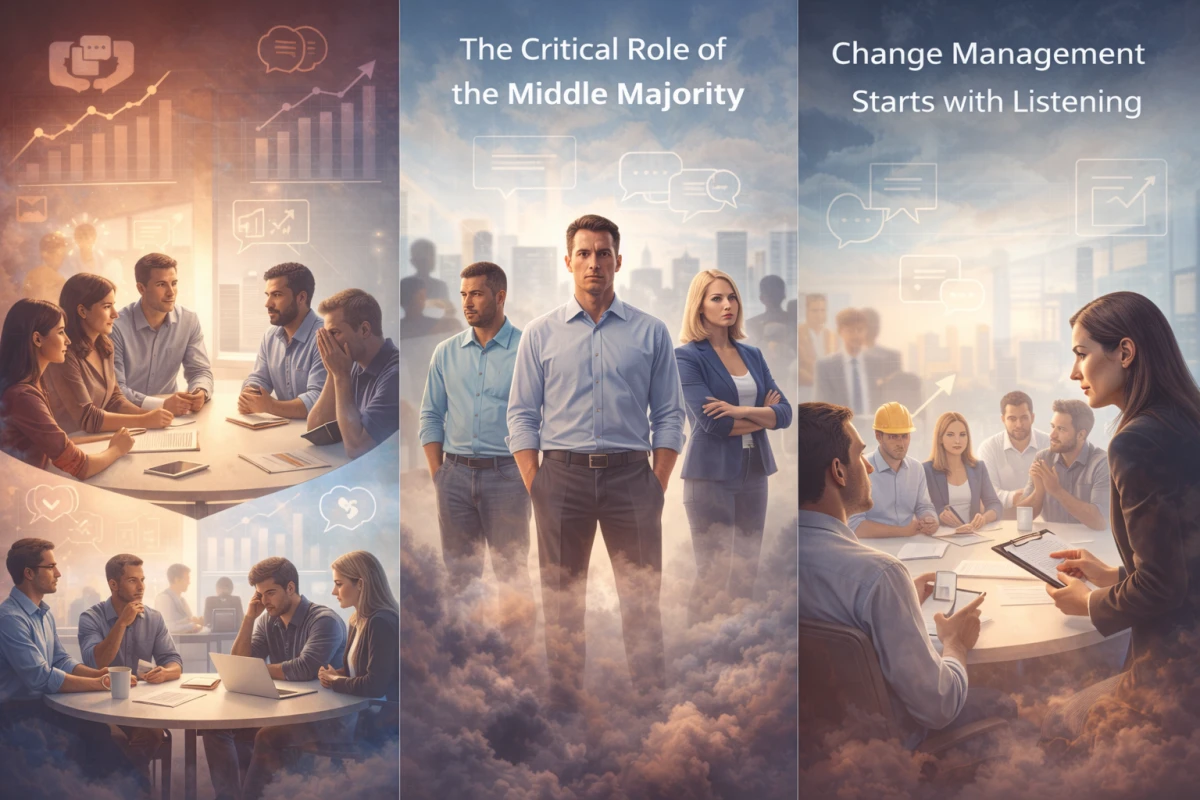

In times of uncertainty, leadership is tested not by authority, but by trust. Recent global events have once again highlighted a reality that HR leaders and talent managers know well: when people feel unheard, insecure, or disconnected from decision-makers, instability follows.
👉 Harvard Business Review on trust in leadership: https://hbr.org/2017/01/the-neuroscience-of-trust
While the context may differ across industries and regions, the underlying leadership dynamics remain universal. Organizations that fail to recognize early warning signs of disengagement often find themselves reacting to crises rather than preventing them.
👉 Gallup research on employee disengagement: https://www.gallup.com/workplace/236927/employee-engagement-drives-growth.aspx
For talent and HR leaders, this moment offers critical lessons in employee engagement, change management, and workforce stability.
👉 McKinsey on people-centric leadership: https://www.mckinsey.com/capabilities/people-and-organizational-performance
 |
Disengagement rarely appears overnight. It builds gradually through unresolved concerns, economic pressure, lack of transparency, and declining trust in leadership.
👉 SHRM on causes of employee disengagement: https://www.shrm.org/resourcesandtools/hr-topics/employee-relations
In organizational settings, this often looks like:
High performers becoming quiet or withdrawn
Reduced discretionary effort
Increased absenteeism or attrition
Resistance to change initiatives
These are not isolated issues. They are signals that the psychological contract between employees and leadership is weakening.
👉 Psychological contract explained: https://www.cipd.org/uk/knowledge/factsheets/psychological-contract-factsheet/
Effective talent management depends on recognizing these patterns early—and acting before morale and productivity decline further.
👉 Deloitte on proactive talent management: https://www2.deloitte.com/global/en/pages/human-capital
One of the most overlooked factors in workforce stability is the role of previously neutral or loyal employees. When this group disengages, organizational momentum shifts rapidly.
👉 Harvard Business Review on middle managers: https://hbr.org/2021/07/the-critical-role-of-middle-managers
In HR terms, this includes:
Long-tenured employees
Operationally critical teams
Managers who once supported leadership decisions
When these groups begin to withdraw trust, disengagement spreads quickly across the organization. At this stage, traditional incentives or reactive communication strategies are often insufficient.
👉 MIT Sloan on trust erosion at work: https://sloanreview.mit.edu/article/repairing-trust-in-the-workplace/
Strong leadership focuses on retaining trust before it fractures, not repairing it after the fact.
Limiting communication during periods of uncertainty creates confusion, speculation, and anxiety. Employees will fill information gaps—often inaccurately—if leadership remains silent.
👉 Gartner on communication during uncertainty: https://www.gartner.com/en/human-resources
From a talent management perspective:
Transparency builds credibility
Consistent communication reduces resistance
Honest messaging supports change adoption
Organizations with open communication cultures are better positioned to navigate restructuring, economic pressure, and workforce transitions.
👉 PwC on transparent leadership: https://www.pwc.com/gx/en/services/people-organisation
Silence, on the other hand, accelerates disengagement.
Successful change management is not about enforcing compliance—it’s about earning alignment.
👉 Prosci on modern change management: https://www.prosci.com/resources/articles
HR leaders play a central role in:
Gathering employee feedback
Identifying morale risks
Advising leadership on engagement strategies
Ensuring change initiatives address real workforce concerns
Listening is not passive. It is a strategic tool that allows organizations to adapt before dissatisfaction becomes systemic.
👉 Forbes on listening leadership: https://www.forbes.com/sites/forbescoachescouncil/
Across industries, the same principles apply:
Trust is a leadership asset that must be actively maintained
Employee engagement is directly linked to organizational stability
Economic and workload pressures amplify disengagement
Early intervention is more effective than crisis response
Organizations that prioritize people-centric leadership outperform those that rely solely on authority or structure.
👉 World Economic Forum on future leadership: https://www.weforum.org/topics/future-of-work
Long-term success in talent management requires more than policies and processes. It requires leadership that understands people, values transparency, and responds decisively to early signs of strain.
For HR and talent leaders, the challenge is clear:
Engage early, communicate clearly, and lead with credibility.
Because once trust is lost, rebuilding it becomes far more difficult—and far more costly.
Looking ahead, organizations must move toward trust-based, people-centric leadership to remain stable in uncertain environments. Continuous employee listening, transparent communication, and strong middle-management capability will be critical to preventing disengagement before it escalates. Leaders who can manage ambiguity, prioritize well-being, and align actions with stated values will be best positioned to retain talent and sustain performance.
👉 McKinsey on leading through uncertainty: https://www.mckinsey.com/featured-insights/leadership
For professionals and candidates, the future belongs to those who seek workplaces where leadership credibility, open dialogue, and employee trust are not promises—but daily practice.
Future Recommendation:
Looking ahead, organizations must move toward trust-based, people-centric leadership to remain stable in uncertain environments. Continuous employee listening, transparent communication, and strong middle-management capability will be critical to preventing disengagement before it escalates. Leaders who can manage ambiguity, prioritize well-being, and align actions with stated values will be best positioned to retain talent and sustain performance. For professionals and candidates, the future belongs to those who seek workplaces where leadership credibility, open dialogue, and employee trust are not promises—but daily practice.
#LeadershipUnderPressure #TrustBasedLeadership #TalentManagement #HRLeadership #EmployeeEngagement #ChangeManagement #WorkforceStability #PeopleStrategy #FutureOfWork #TransparentLeadership #EmployeeTrust #PeopleCentric #OrganizationalCulture #LeadershipLessons