Top Soft Skills Australian Companies Want Right Now
Your resume might get you noticed, but your soft skills will get you hired — and promoted. As AI takes over routine tasks across Australian workplaces, employers are doubling down on the skills only humans can truly deliver. Here's what's at the top of their list right now.
87%
of AU jobs now require digital + soft skill combo
70%
of organisations say soft skills outweigh technical ones
81%
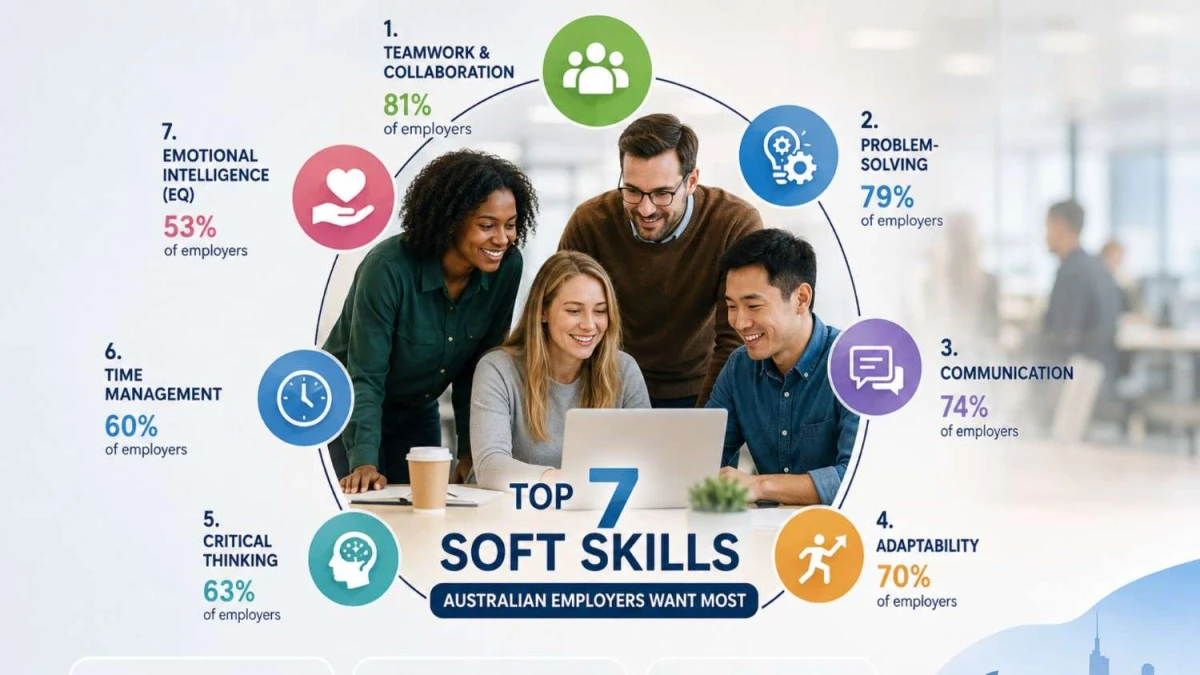
of AU employers rank teamwork as #1 soft skill
The 7 soft skills topping Australian hiring lists
Hays surveyed over 3,500 Australian employers and found teamwork sitting firmly at the top. In hybrid and distributed workplaces, the ability to collaborate across different personalities, time zones, and communication styles is more valuable than ever. Companies aren't just looking for people who "work well with others" — they want people who actively bring out the best in their teams.
With automation handling repetitive work, humans are increasingly expected to handle the complex, ambiguous, and novel challenges machines can't crack. Australian employers specifically want people who stay calm under pressure, think laterally, and approach obstacles with a constructive attitude — not just those who escalate or wait for instructions.
SEEK's 2024 data shows communication as the most requested skill across job ads in customer service, care work, education, and administration. But this goes well beyond speaking clearly — it means listening actively, writing concise reports, giving effective feedback, and navigating difficult conversations with empathy. In an era of messaging apps and async work, communicating well is harder and more valued than ever.
The World Economic Forum's Future of Jobs Report 2025 identifies adaptability as the standout skill for 2026. With 44% of workers' skills expected to change within five years, employers across Australia are prioritising people who embrace change, learn fast, and don't wait to be told what's next. In a skills-first hiring world, the ability to pivot is itself a career asset.
Deloitte's Human Capital Trends report highlights a widening gap in critical thinking across Australian workplaces. As AI generates content and surfaces options at speed, the humans who can evaluate, question, and decide become the real differentiators. Leaders and individual contributors alike are expected to examine information carefully, spot flawed assumptions, and make sound judgements — skills no algorithm can replicate reliably.
Hybrid work has blurred the lines between professional and personal time, making self-directed scheduling a genuine professional skill. Australian companies — especially those with remote or distributed teams — need people who can prioritise ruthlessly, meet deadlines without hand-holding, and protect deep-work time in a world of constant notifications. Good time management signals maturity, reliability, and respect for colleagues' time.
Forbes named EQ the number one soft skill for 2025, and TalentSmart research shows it accounts for more than half of workplace performance. In Australian workplaces — particularly those managing hybrid teams or navigating mental health challenges — leaders and employees with high EQ build stronger relationships, resolve conflicts with less drama, and keep morale high through uncertainty. It's no longer a "nice to have": it's a leadership essential.
The AI factor: As artificial intelligence handles more routine tasks, human skills are becoming the last true competitive advantage. Deloitte research shows more than 70% of Australian organisations now believe soft skills carry more weight than technical ones — yet only a third feel confident their teams have them. The gap is your opportunity.
How to develop these skills quickly
You don't need to go back to university. Micro-credentials, online courses through TAFE and LinkedIn Learning, and even volunteering are fast, affordable ways to build and demonstrate soft skills. Ask colleagues for honest feedback, take on stretch assignments, and document real examples — specific stories of communication wins, team conflicts resolved, or adaptive pivots matter far more than claims on a resume. In a skills-first hiring environment, showing beats telling every time.
The bottom line: Australia's most sought-after employees in 2026 aren't just technically sharp — they're collaborative, curious, emotionally grounded, and genuinely good at working with other humans. That combination is both rare and increasingly valuable.
Sources
#SoftSkills #AustraliaJobs #HiringTrends2026 #FutureOfWork #CareerGrowth #JobReadySkills #CommunicationSkills #Teamwork #ProblemSolving #Adaptability #EmotionalIntelligence #CriticalThinking #TimeManagement #AustralianEmployers #WorkplaceSkills #AIAndJobs #CareerSuccess #ProfessionalDevelopment #JobSearchAustralia #SearchTalents