
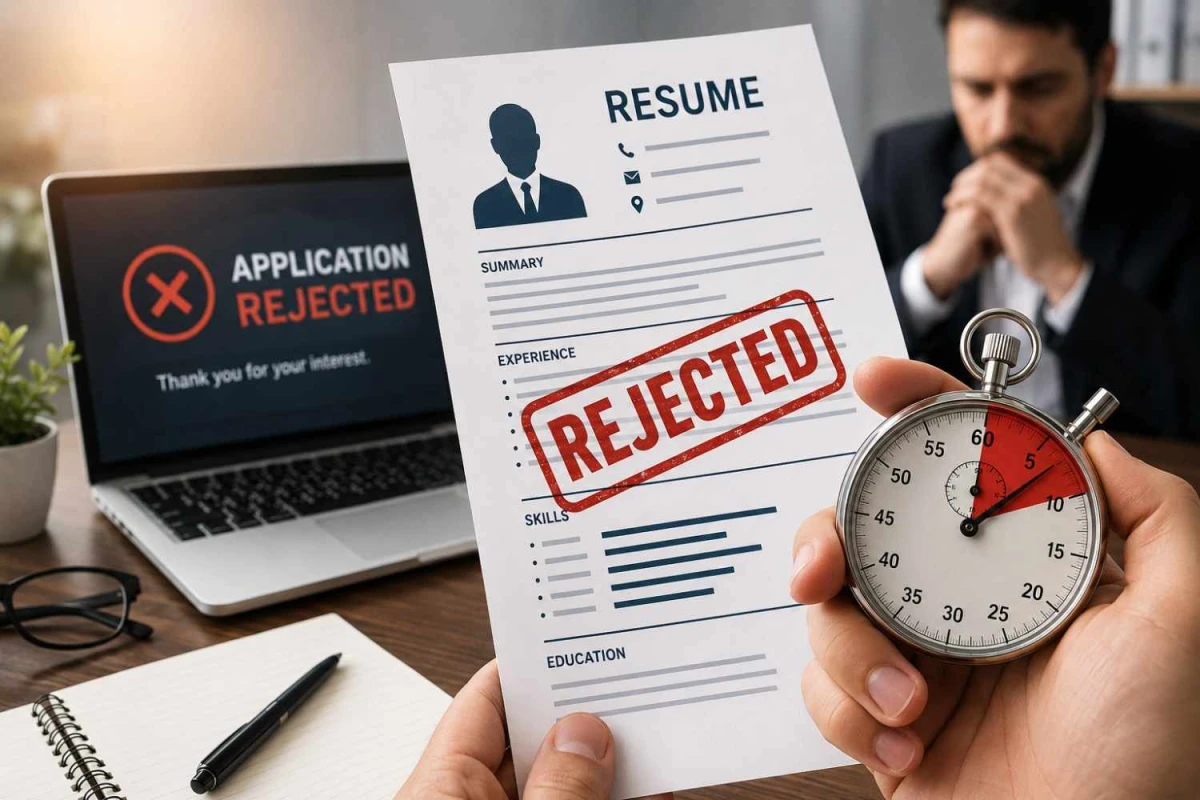

You spend hours creating your resume.
You update skills, add experience, adjust formatting, and apply to dozens of jobs with hope.
But then nothing happens.
No interview calls.
No recruiter response.
No updates.
The reality is harsh: most resumes are rejected within just a few seconds.
In today’s competitive hiring market, recruiters receive hundreds of applications for a single role. They simply do not have enough time to read every resume in detail. Instead, they quickly scan resumes to decide whether a candidate matches the role or not.
If your resume fails to create a strong first impression immediately, it gets skipped.
And in many cases, the rejection happens before a human even reads it.
Studies and recruiter behavior show that hiring managers usually spend only a few seconds scanning a resume initially.
During this short scan, recruiters mainly check:
If these things are difficult to find or poorly presented, your application quickly moves to the rejection pile.
This does not always mean you are unqualified.
Sometimes the problem is simply how your resume communicates your value.
First impressions matter.
A resume filled with large paragraphs, multiple colors, fancy graphics, or inconsistent formatting becomes hard to scan quickly.
Recruiters prefer resumes that are:
If important information is hidden inside cluttered design, recruiters may lose interest instantly.
Simple resumes often perform better than overly designed ones.
One of the biggest mistakes candidates make is sending the same generic resume everywhere.
Modern companies use ATS (Applicant Tracking Systems) to filter applications automatically. These systems scan resumes for keywords related to the job description.
For example:
If your resume lacks the right keywords, ATS software may reject it before a recruiter even sees it.
Customizing your resume for each role dramatically improves your chances.
Many candidates still do not understand how ATS works.
ATS software is designed to save recruiters time by filtering applications automatically. It checks:
If your resume does not align with the job description, the system may rank your application lower.
That’s why keyword optimization is now essential in job searching.
A strong resume is not just written for humans anymore — it is also written for software systems.
Many resumes only describe responsibilities.
Example:
“Managed social media accounts.”
This sounds basic and generic.
Recruiters care more about impact and measurable results.
A stronger version would be:
“Increased Instagram engagement by 45% within 3 months through targeted content strategies.”
Numbers instantly make your profile more powerful.
Companies want candidates who can create results, not just complete tasks.
The top section of your resume is extremely important.
If your introduction sounds generic, recruiters lose interest quickly.
Weak example:“Looking for an opportunity to grow my career.”
Better example:
“Digital Marketing Specialist with 3+ years of experience in SEO, paid advertising, and lead generation campaigns that improved conversions by 38%.”
A strong summary immediately communicates value.
It tells recruiters:
Recruiters want quick visibility.
If they cannot immediately identify your core skills, your chances decrease.
Your skills section should be:
Example skills for different industries:
Avoid adding irrelevant or outdated skills that do not match the role.
A large number of recruiters review resumes on mobile devices.
Poor formatting can destroy readability.
Common issues include:
Always:
A technically broken resume can cost you opportunities even if your experience is strong.
Recruiters are searching for clarity and relevance.
They want to quickly understand:
The easier you make their job, the better your chances become.
Your resume should immediately answer:
“Why should this person be interviewed?”
Here are practical ways to strengthen your resume in 2026:
Small improvements can create major results.
Hiring is changing rapidly.
AI tools, automation, and ATS systems are becoming a major part of recruitment processes worldwide. Companies now prioritize resumes that are:
Candidates who adapt to these changes will have a much better chance of getting noticed.
The old method of mass applying with one generic resume is becoming less effective every year.
Your resume is often your first impression in front of an employer.
And in many cases, you only have a few seconds to prove your value.
That’s why presentation, clarity, and relevance matter more than ever.
A cleaner design, stronger achievements, better keywords, and role-specific customization can significantly increase your chances of getting interview calls.
Sometimes the difference between rejection and selection is not experience — it is how effectively your resume communicates it.
Because in today’s hiring world, surviving the first 6 seconds can change your entire career.