
Artificial Intelligence is no longer a future discussion. It is already part of daily work, business decisions, hiring systems, customer service, marketing, finance, education and almost every modern industry. For many job seekers, students and working professionals, this creates one big question: will AI take away jobs, or will it simply change the way people work?
The honest answer is that AI is not replacing every job. It is changing how jobs are done.
This change can feel scary because every new technology brings uncertainty. When computers entered offices, people worried that clerical jobs would disappear completely. When the internet became common, many traditional businesses feared they would not survive. When automation entered factories, workers worried about machines taking over production. But in every major shift, work did not end. It changed. Some tasks became outdated, some skills became less useful, and new career opportunities appeared.
AI is creating a similar shift today.
A job is never just one task. A marketing executive does not only write captions. A recruiter does not only screen resumes. An accountant does not only enter numbers. A customer support officer does not only answer basic questions. Every role includes many different activities, and AI is mainly affecting the repetitive and predictable parts of those roles.
For example, AI can help write a first draft of an email, but it cannot fully understand a company’s brand voice without human direction. AI can shortlist resumes, but it cannot completely judge attitude, communication, confidence or cultural fit. AI can create reports from data, but it cannot always explain what those numbers mean for a real business situation.
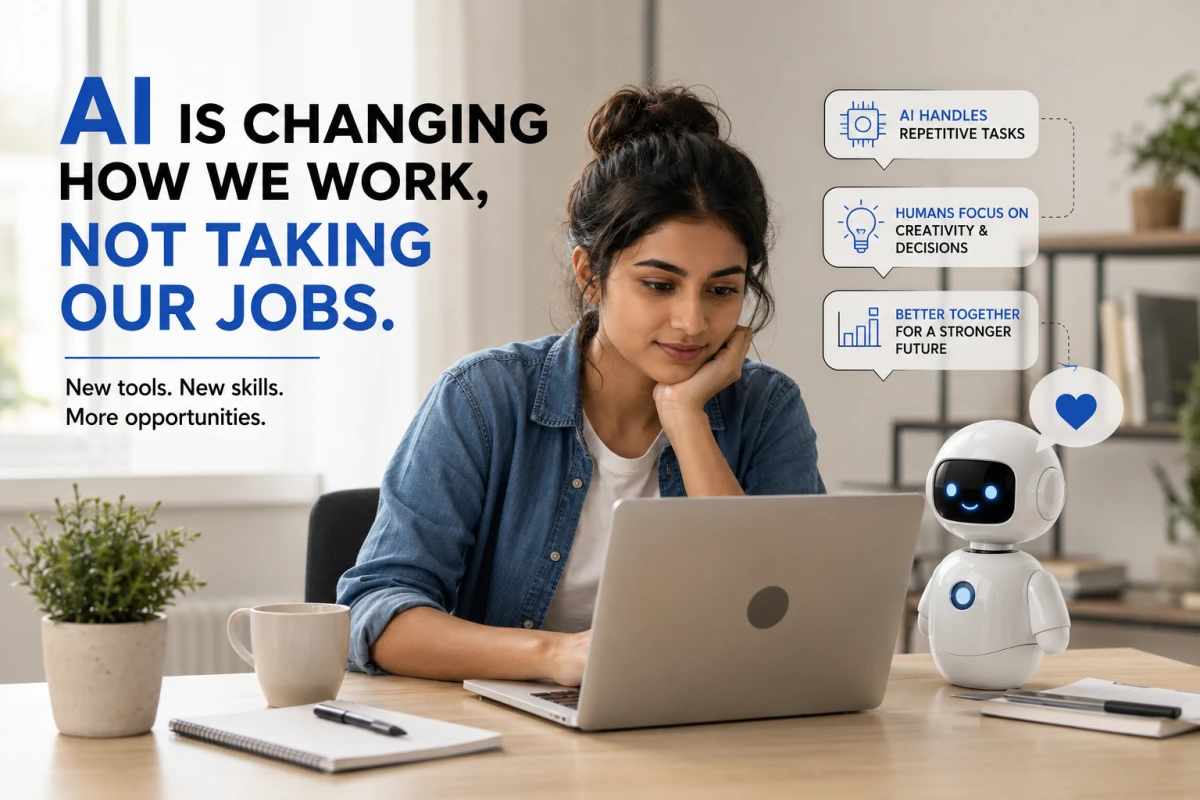
This means professionals who learn how to use AI properly can become more productive. Instead of spending hours on basic tasks, they can focus on decision-making, communication, planning and problem-solving.
The future workplace will not only ask, “Can you do this task?” It will ask, “Can you use the right tools, understand the output and make better decisions?”
AI feels threatening because it is fast. It can write, analyse, summarise, calculate, translate and generate ideas in seconds. For someone who has spent years doing manual work, this can feel uncomfortable. If a tool can do in five minutes what a person used to do in three hours, it is natural to worry.
But speed is not the same as responsibility.
AI can produce content quickly, but it can also make mistakes. It can summarise information, but it may miss context. It can suggest answers, but it does not carry accountability. In professional environments, accountability matters. A business still needs people who can check, refine, approve, explain and take responsibility for final decisions.
That is why human involvement remains important.
The people most at risk are not those whose industries use AI. The people most at risk are those who refuse to learn, adapt or improve their skills. A person who uses AI as a support tool can become faster and more valuable. A person who ignores AI completely may slowly fall behind.
In the past, many careers were built around fixed job titles. People would say, “I am a content writer,” “I am an accountant,” “I am a customer support agent,” or “I am a recruiter.” Today, job titles are still important, but skills matter more.
Employers are now looking for people who can combine technical ability with human judgment. A content writer who can use AI tools, edit strongly and understand audience behaviour has an advantage. A recruiter who can use AI screening tools but still build strong candidate relationships is more valuable. A finance professional who can automate reports and explain financial insights clearly will stand out.
This is the new career reality: job titles may change, but useful skills continue to grow in value.
The strongest professionals will be those who can work with AI, not against it.
One surprising result of AI growth is that human skills are becoming more important, not less. As machines handle more repetitive work, employers are placing higher value on skills that technology cannot easily replace.
Communication is one of the biggest examples. AI can generate a message, but it cannot always understand tone, emotion or timing. In business, the way something is said often matters as much as what is said.
Problem-solving is another key skill. AI can provide suggestions, but a person still needs to identify the real problem. Many workplace issues are not simple. They involve people, pressure, deadlines, budgets and incomplete information. Human judgment is needed to handle these situations.
Emotional intelligence is also becoming more valuable. Customers, clients and teams still want to deal with people who understand them. A chatbot can answer basic questions, but it cannot build long-term trust in the same way a reliable human professional can.
Leadership, creativity, adaptability and critical thinking are no longer “soft skills.” They are career survival skills.
AI is not only changing existing jobs. It is also creating new roles. Many companies now need people who can manage AI tools, review AI-generated content, train systems, check accuracy, improve workflows and ensure responsible use of technology.
Roles such as AI content editor, automation specialist, prompt specialist, AI trainer, chatbot designer and AI workflow coordinator are becoming more common. These jobs did not exist in the same way a few years ago.
This is important for students and freshers. Instead of fearing AI, they should see it as a new career area. A fresher who understands AI tools, basic digital systems, communication and industry knowledge can enter the job market with a stronger profile.
The same applies to experienced professionals. Someone with five or ten years of industry experience can become even more valuable by learning how AI can improve their existing work. Experience plus AI skills is a powerful combination.
For freshers, the goal should not be to become dependent on AI. The goal should be to become AI-ready.
This means learning how to use common AI tools for research, writing, analysis, presentations and productivity. It also means understanding their limits. AI should support your thinking, not replace it.
Freshers should focus on building a mix of skills: communication, resume writing, interview confidence, industry knowledge, digital tools, teamwork and problem-solving. Employers want candidates who are practical, adaptable and ready to learn.
A student who can use AI to prepare better, research faster and present ideas clearly will have an advantage over someone who only uses AI to copy answers.
For working professionals, the first step is to look at daily work honestly. Which tasks are repetitive? Which tasks require judgment? Which tasks can be improved with AI tools?
Once this is clear, professionals should start using AI to reduce time spent on low-value work. For example, AI can help prepare meeting notes, summarise reports, create first drafts, organise data and generate ideas. The saved time can then be used for strategy, client communication, team management and better decision-making.
Professionals should also keep learning. Short courses, workshops, online tutorials and practical experimentation can make a big difference. The workplace is changing quickly, and waiting too long can make adaptation harder.
The best approach is simple: learn the tool, understand the work, and improve the result.
The future of work will not be AI versus humans. It will be AI with humans.
Businesses still need people who can understand customers, manage relationships, solve problems, lead teams, make decisions and take responsibility. AI can support these areas, but it cannot fully replace the human side of work.
The real change is that average work will no longer be enough. People will need to keep improving. They will need to become more flexible, more skilled and more comfortable with technology.
This is not bad news. It is a chance to grow.
AI will change jobs, but it does not mean careers are ending. The people who adapt will find new opportunities. The people who learn how to use AI will work faster and smarter. The people who combine technology with human skills will become even more valuable.
The future belongs to professionals who are willing to upgrade themselves.
AI may change the tools we use, the tasks we do and the way companies operate. But human judgment, creativity, communication and trust will remain at the centre of meaningful work.
So the real question is not, “Will AI take my job?”
The better question is, “How can I use AI to become better at my job?”
#AIJobs #FutureOfWork #ArtificialIntelligence #CareerGrowth #JobSkills #WorkplaceTechnology #DigitalSkills #AIReady #CareerDevelopment #SmartWork #SkillDevelopment #JobMarket #HumanSkills #Automation #CareerTips