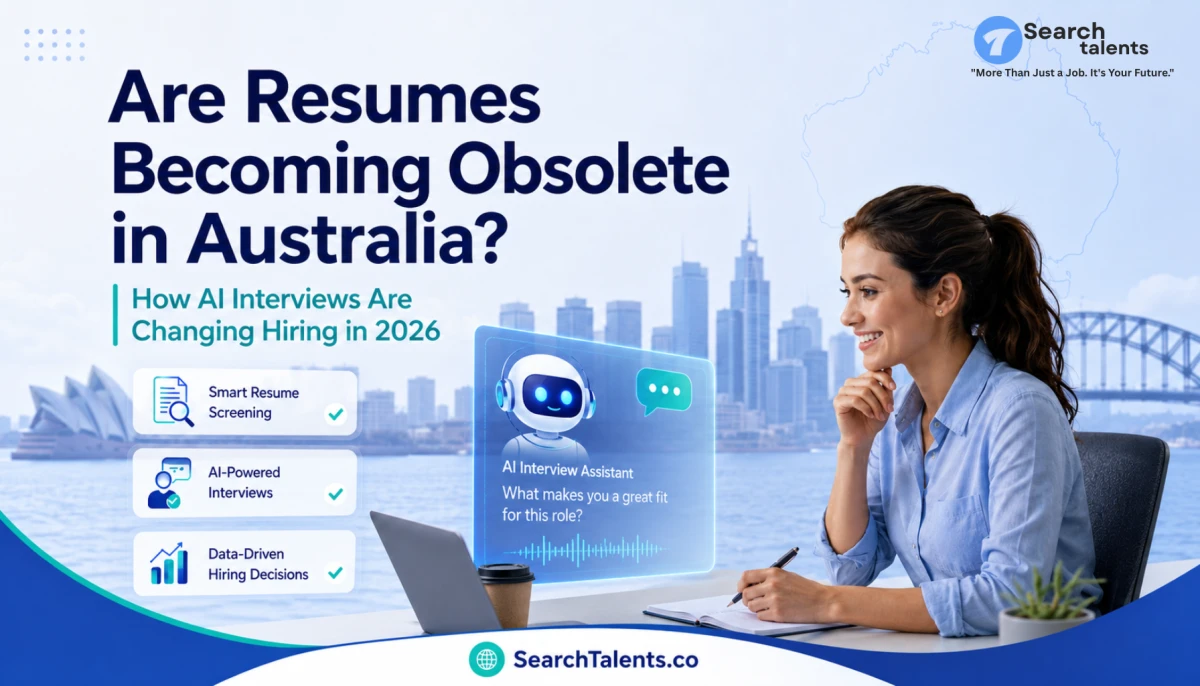
For decades, the resume has been the most important part of a job application. Candidates carefully listed their education, experience and skills, while recruiters used those details to decide who deserved an interview.
In 2026, that traditional process is beginning to change.
Australian employers are receiving increasing numbers of highly polished and AI-assisted applications. At the same time, businesses are adopting automated screening, chat-based assessments and skills-focused interviews to identify candidates more efficiently.
This does not mean resumes will disappear overnight. However, the resume may no longer be the only—or even the most important—factor determining who moves forward in the hiring process.
Australia’s Hiring Market Is Becoming More Selective
Australia still has a significant number of employment opportunities. The Australian Bureau of Statistics reported approximately 329,500 job vacancies in May 2026, although this represented a 2.1% decline from February 2026. These figures show that employers are still hiring, but the market is becoming more competitive.
When employers receive hundreds or thousands of applications for one position, manually reading every resume becomes difficult. Recruitment teams therefore use applicant tracking systems, automated matching tools and artificial intelligence to identify potentially suitable candidates.
SEEK research indicates that candidates are already using AI to prepare resumes and cover letters, while employers are increasingly open to using AI for tasks such as writing job advertisements, screening resumes and scheduling interviews.
The result is a hiring environment in which technology is being used on both sides of the application process.
Why Traditional Resumes Are Losing Some of Their Value
AI tools can help candidates improve grammar, organise information and tailor applications to job descriptions. Used carefully, this can make the application process more accessible.
The problem begins when large numbers of candidates use similar tools, prompts and templates.
Recruiters have warned that AI-generated resumes can begin to look and sound almost identical. Applications may contain the correct keywords and polished language without clearly demonstrating the candidate’s real personality, judgement or ability.
A resume may say that someone has excellent communication skills, but it does not necessarily show how that person communicates under pressure.
It may describe someone as adaptable, but it does not explain how they responded when workplace priorities suddenly changed.
This is why some employers are moving beyond the resume and introducing assessments that allow candidates to demonstrate their qualities more directly.
Anchor Text: Explore the latest jobs in Australia https://searchtalents.co/search-jobsAdd this link in the job search preparation section or the conclusion.
Anchor Text: Australian job market insights and hiring trends https://searchtalents.co/insightsAdd this link in the section discussing changes in Australia’s hiring market.
Kmart’s AI Interview Model Shows How Hiring Is Changing
One of the clearest examples comes from Kmart Group, which has used a chat-based AI interview during the early stages of recruitment for frontline roles.
Instead of relying only on a traditional CV, candidates answer a structured series of questions designed to assess areas such as:
Communication
Teamwork
Adaptability
Problem-solving
Willingness to help others
The system is particularly relevant for younger applicants and entry-level candidates who may have limited formal work history.
According to reporting and information published by the technology provider, Kmart’s approach has been used to manage approximately 600,000 applications annually. The organisation reportedly reduced its hiring time significantly and experienced stronger retention among candidates identified as suitable through the assessment process. Human recruiters still remain involved in final hiring decisions.
This example demonstrates an important change: employers may be more interested in how a candidate thinks, communicates and responds than in how professionally their resume has been formatted.
What AI Interviews May Ask Candidates
An automated interview may not feel like a traditional face-to-face interview. Candidates might receive written questions through a chatbot or be asked to complete a recorded video response.
Typical questions could include:
Describe a time you helped a customer or colleague.
What would you do if your manager changed your priorities unexpectedly?
Tell us about a problem you solved.
How would you respond to an unhappy customer?
Describe a situation in which you worked as part of a team.
These are behavioural questions. The employer is looking for evidence rather than general claims.
A response such as “I am a good team player” is unlikely to be strong enough. Candidates need to explain the situation, their actions and the result.
How Job Seekers Should Prepare for AI-Based Hiring
1. Prepare Real Workplace Examples
Candidates should prepare examples covering communication, teamwork, conflict, problem-solving, customer service, leadership and adaptability.
These examples can come from:
Previous employment
Internships
Volunteer work
University assignments
Training placements
Community activities
Personal projects
The example does not need to be dramatic. It needs to be genuine, relevant and clearly explained.
2. Use the STAR Method
The STAR method gives interview responses a clear structure:
Situation: What was happening? Task: What responsibility did you have? Action: What did you personally do? Result: What happened because of your actions?
This structure is useful for human interviews, recorded interviews and written AI assessments.
3. Do Not Copy Generic AI Answers
AI can help candidates practise questions or improve the structure of an answer. However, copying an artificially perfect response can make the application sound impersonal.
The strongest answers include specific details that only the candidate could provide.
Instead of writing:
“I successfully managed a challenging customer interaction using strong communication skills.”
A better response would explain what the customer needed, what went wrong, how the candidate responded and what outcome was achieved.
4. Keep the Resume Accurate
Even when an employer uses an AI assessment, a resume may still be reviewed later.
Candidates should not add experience, qualifications or skills they cannot verify. Recruiters may identify inconsistencies during interviews, reference checks or practical assessments.
A simple and honest resume is more valuable than an impressive document containing exaggerated claims.
5. Build a Complete Professional Profile
Employers may review more than the submitted resume. They can also consider professional profiles, verified skills, work history, availability and the candidate’s communication during the application process.
Job seekers should ensure that their online information is consistent and current.
A complete candidate profile can also help employers discover suitable applicants without depending entirely on a single resume submission.
What Employers Should Consider Before Using AI Recruitment
AI can improve efficiency, but it should not be treated as a complete replacement for human judgement.
Employers should ensure that recruitment technology assesses factors that are genuinely relevant to the role. Candidates should also receive clear information about how the assessment works and what happens to the information they provide.
Research and reporting have raised concerns that poorly designed recruitment systems may create or reinforce unfair outcomes. This makes transparency, regular review and human oversight particularly important.
A responsible recruitment process should:
Use consistent, job-relevant questions
Avoid unnecessary personal information
Provide reasonable accessibility options
Allow human review of important decisions
Protect candidate information
Regularly examine the system for unfair outcomes
Technology should make recruitment more relevant and efficient—not make candidates feel invisible.
Will Resumes Completely Disappear?
Resumes are unlikely to disappear across every industry.
Professional, technical, academic and senior-level roles may still require detailed information about qualifications, employment history, projects and achievements.
However, resumes may become only one component of a broader process.
A future hiring journey could include:
A short candidate profile
A skills or personality assessment
A written or video-based AI interview
A practical task
A conversation with a recruiter or hiring manager
This process gives employers more information than a resume alone.
It may also create opportunities for candidates who have strong practical abilities but limited experience writing professional applications.
Skills Will Matter More Than Perfect Formatting
The most important lesson for Australian job seekers is that presentation alone is no longer enough.
A well-written resume can still help someone enter the recruitment process, but employers increasingly want evidence that the candidate can perform the role.
Candidates should focus on developing and demonstrating:
Clear communication
Digital literacy
Problem-solving
Reliability
Customer service
Adaptability
Teamwork
Role-specific technical skills
These abilities are difficult to prove through generic statements. They become more convincing through real examples, verified experience and thoughtful interview responses.
How SearchTalents.co Supports Modern Recruitment
As hiring becomes more skills-focused, job seekers need platforms that allow them to present relevant information clearly and discover opportunities that match their experience.
SearchTalents.co helps job seekers explore job opportunities and build a professional presence employers can review. It also helps recruiters and businesses connect with active, job-ready candidates through a dedicated employment platform.
For candidates, the objective should not be to submit the highest number of applications. It should be to create a strong profile, target suitable roles and communicate their value clearly.
For employers, the objective should be to reach relevant candidates and use a fair, transparent recruitment process to identify the right person.
Conclusion
The resume is not dead, but its role is changing.
As AI-generated applications become more common, employers are looking for better ways to understand the person behind the document. Chat-based interviews, behavioural assessments, skills testing and professional profiles are becoming increasingly important.
Job seekers who depend only on a polished resume may struggle to stand out. Those who can demonstrate genuine communication, adaptability, problem-solving and workplace readiness will be better prepared for the changing Australian hiring market.
In 2026, getting hired is no longer simply about having the perfect resume. It is about providing credible evidence that you are capable, suitable and ready to contribute.
Skills-based hiring focuses on a candidate’s practical abilities rather than only qualifications or job titles. Employers may use interviews, assessments and work samples to verify those skills.
Communication, adaptability, teamwork, problem-solving and digital literacy are increasingly important. Role-specific technical skills also remain essential.
Job seekers can provide specific examples, measurable achievements and practical work samples. A complete professional profile can also help employers understand their experience.
An AI interview uses automated technology to ask questions and assess candidate responses. It may be completed through chat, video or written answers.
AI interviews mainly support early screening and high-volume recruitment. Human recruiters and hiring managers usually remain involved in final decisions.
Candidates should practise behavioural questions and prepare genuine workplace examples. Clear, relevant and well-structured answers are more effective than generic responses.
Resumes are not disappearing, but employers are relying on additional assessments. Skills tests, AI interviews and practical tasks are becoming more important.
Yes, many employers still review resumes during recruitment. However, automated systems may screen applications before a recruiter sees them.
Candidates can use AI to improve structure, grammar and relevance. They should still ensure that every qualification, achievement and skill is accurate.