
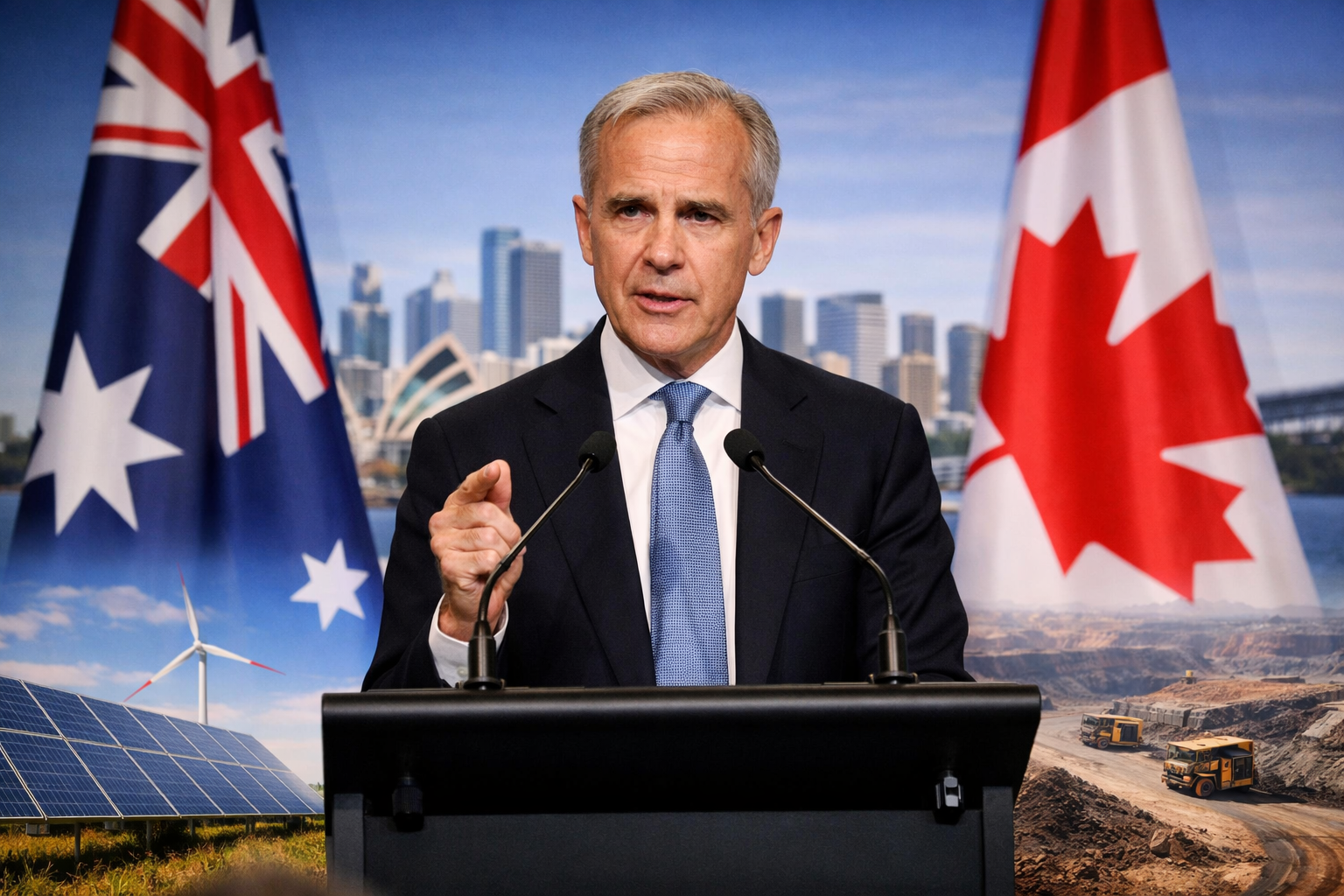

Canadian Prime Minister Mark Carney has warned that countries like Australia and Canada could become increasingly dependent on global superpowers if middle-sized economies fail to strengthen cooperation in technology, trade, and strategic industries.
Speaking at the Lowy Institute in Sydney, Carney said that economic integration has sometimes placed smaller economies in a vulnerable position, where supply chains and technological infrastructure are dominated by major global powers.
He explained that many governments have prioritised economic efficiency for decades, creating supply chains that rely heavily on dominant nations and multinational technology companies.
Global economic changes like these directly influence jobs, industries, and workforce demand.
As countries invest more in technology, defence, and strategic industries, new opportunities are expected to emerge for skilled professionals in sectors such as artificial intelligence, renewable energy, cybersecurity, and advanced manufacturing.
Students and job seekers looking to build careers in these growing sectors can explore emerging opportunities and career resources on SearchTalents:
https://searchtalents.co
Employers seeking qualified professionals in technology and innovation sectors can also connect with global talent through the SearchTalents employer platform:
https://searchtalents.co/employers
Carney highlighted that several key sectors are currently dominated by companies linked to the United States and China, including:
He stressed that countries like Australia and Canada must develop sovereign capabilities in critical sectors to ensure their economic independence.
A major area of cooperation between the two nations is critical minerals, which are essential for electric vehicles, renewable energy technologies, and modern electronics.
During Carney’s visit to Canberra, both countries are expected to discuss agreements that could create one of the world’s largest reserves of critical minerals among trusted democratic nations.
Such partnerships could strengthen global supply chains and reduce reliance on dominant suppliers.
Carney also pointed out that around 70% of Canada’s defence spending currently goes to US entities, which he suggested may create long-term strategic risks.
Canada has already launched a multi-billion-dollar plan to strengthen its military and diversify defence partnerships.
This shift may lead to greater collaboration between Australia and Canada in areas such as defence technology, security cooperation, and advanced research.
According to Carney, middle powers such as Australia, Canada, Japan, South Korea, and European nations collectively represent enormous economic strength.
Together they have:
For students and professionals planning future careers, these developments could create growing demand for skills in technology, engineering, cybersecurity, renewable energy, and global trade.
Graduates looking for international career opportunities in these sectors can explore job listings and career insights through the SearchTalents jobs portal:
https://searchtalents.co/jobs
Carney also discussed his interactions with global leaders including Donald Trump and Xi Jinping.
While he acknowledged diplomatic challenges, he emphasised the importance of maintaining open dialogue and setting clear boundaries in international relationships.
He also suggested that Australia’s approach to managing its relationship with China provides useful lessons for Canada.
Carney’s remarks highlight how the global economy is entering a new phase where technology, strategic resources, and geopolitical partnerships will shape the future.
For businesses, students, and professionals, this transformation may open new opportunities in emerging industries and international collaboration.
Career platforms like SearchTalents are increasingly helping professionals stay informed about global workforce trends and connect with employers across growing industries:
https://searchtalents.co
ABC News Australia – https://www.abc.net.au/news
Reuters – https://www.reuters.com
BBC News – https://www.bbc.com/news
The Guardian – https://www.theguardian.com/world
Lowy Institute – https://www.lowyinstitute.org