
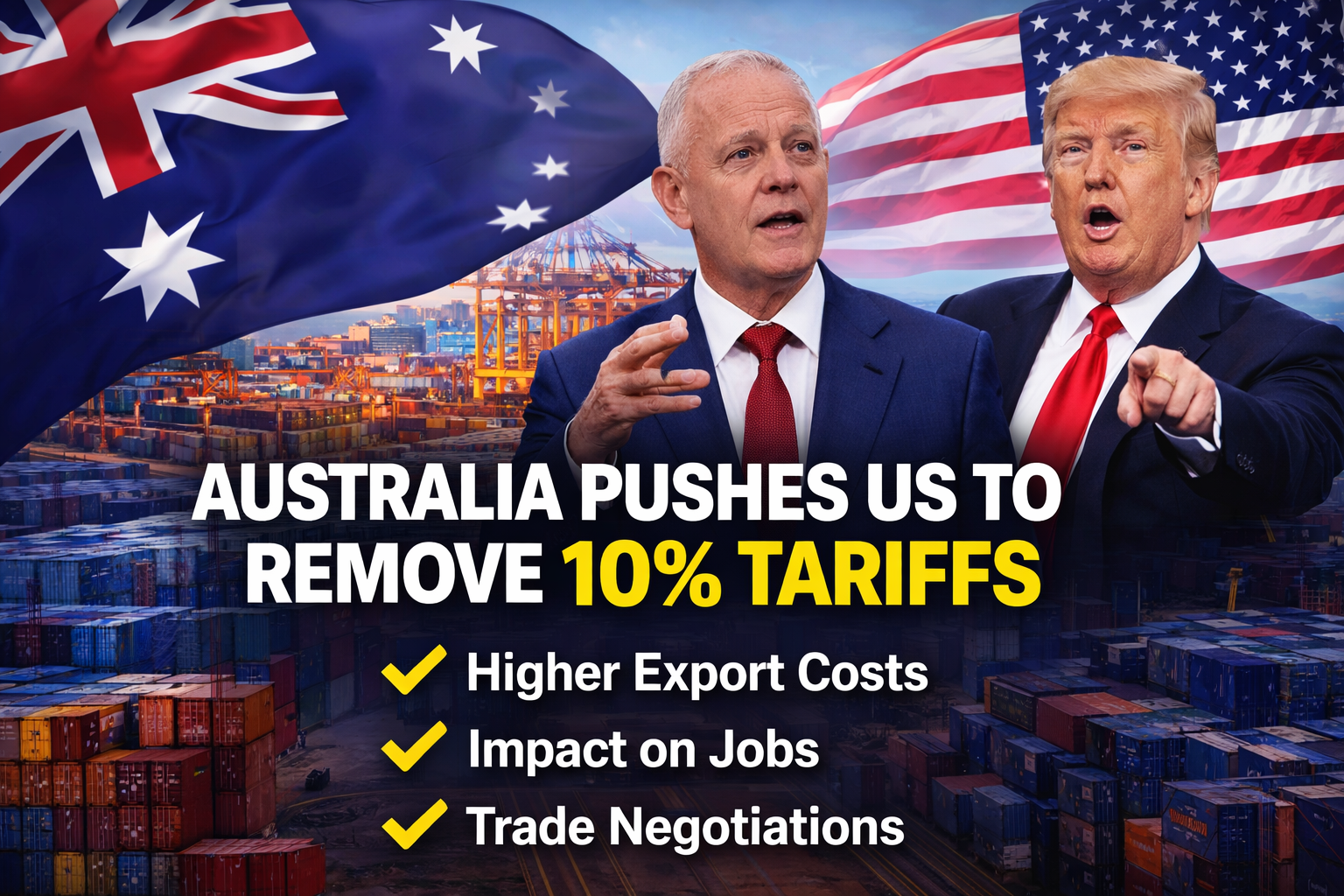

Australia’s Trade Minister Don Farrell is lobbying the United States to remove a 10 percent import tariff introduced under policies backed by Donald Trump.
According to ABC News Australia, the US tariff currently remains at 10 percent, despite earlier threats it could rise to 15 percent. Farrell confirmed that Australia will argue for complete removal of the levy during talks with US Trade Representative Jamieson Greer.
Source: https://www.abc.net.au/news/2026-02-26/australia-to-escape-higher-tariffs-threatened-by-trump/106390024
Coverage by News.com.au reported Farrell describing the tariffs as “not justified,” warning they push up prices for both Australian exporters and American consumers.
Source: https://www.news.com.au/finance/economy/world-economy/not-justified-australia-lobbying-united-states-for-zero-tariffs/news-story/f2a229170bed052ebe528ff25adbf056
International reporting from Reuters also highlighted Australia’s criticism of the tariffs, with officials previously describing the move as inconsistent with the spirit of trade cooperation.
Source: https://www.reuters.com/world/australia-says-us-tariffs-not-act-friend-rules-out-reciprocal-move-2025-04-02/
Additional reporting by Xinhua News confirmed Farrell’s objective to negotiate a full removal of the 10 percent surcharge and align trade terms with existing agreements.
Source: https://english.news.cn/asiapacific/20260226/f5aba34b3014479fa2183edf9fa8b3ff/c.html
The tariff dispute follows a decision by the Supreme Court of the United States, which struck down several earlier tariffs introduced under Trump’s “Liberation Day” framework. The ruling strengthened Australia’s argument that the measures were not legally sound.
ABC News further reported that Australian exporters could benefit significantly if tariffs are deemed unlawful and removed.
Source: https://www.abc.net.au/news/2026-02-20/australian-exporters-windfall-over-trump-tariffs-court-ruling/106363368
A 10 percent tariff increases the cost of Australian goods entering the US market. Key industries affected include:
When export costs rise, employers may delay expansion, freeze hiring, or reduce margins.
Australia’s argument is based on the existing Australia–United States Free Trade Agreement, which aims to reduce trade barriers between the two nations.
Background: https://en.wikipedia.org/wiki/Australia%E2% 80%93United_States_Free_Trade_Agreement
Official updates from Australia’s Department of Foreign Affairs and Trade outline the latest developments on US tariff measures and their impact on exporters.
Source: https://www.dfat.gov.au/trade/trade-and-investment/latest-us-tariffs
Trade instability directly impacts recruitment in:
When global tariffs increase, companies adjust hiring strategies. Students pursuing business, economics, and international trade should understand that policy shifts influence job demand.
Farrell argues that tariffs increase prices for American consumers, contributing to cost-of-living pressures in the US. When import taxes rise:
Trade policy decisions made in Washington and Canberra do not stay local. They shape global employment trends.
Australia is not negotiating for a reduced rate. It is demanding complete removal of tariffs in line with free trade principles.
The outcome of discussions between Don Farrell and US officials will influence export competitiveness, business investment decisions, and hiring across trade-linked industries.
For employers and job seekers on SearchTalents, global trade policy is not background noise. It directly impacts opportunity, growth, and workforce stability.