
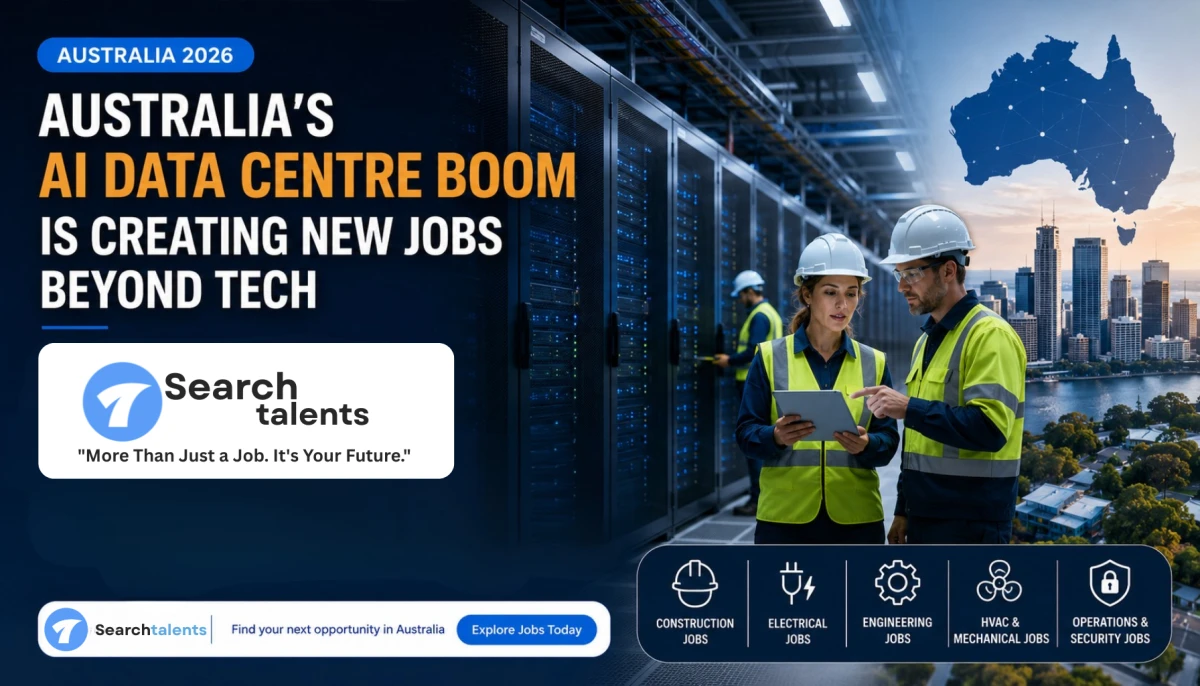
Artificial intelligence is often discussed as a technology that may replace jobs. However, the rapid growth of AI is also creating a different type of employment opportunity across Australia.
AI systems require large amounts of computing power. This power is provided through data centres—high-security facilities containing servers, cooling systems, electrical infrastructure and communication networks.
As investment in Australian data centres increases, demand is growing not only for IT professionals but also for electricians, construction workers, engineers, technicians, security staff and project managers.
For many Australian job seekers, the AI boom may create opportunities in roles that do not require advanced coding skills.
Businesses are using cloud computing, artificial intelligence, digital payments and online platforms more frequently. These services require secure facilities where large amounts of information can be processed and stored.
The Australian Bureau of Statistics reported that data-centre investment contributed to an 8.8% increase in non-mining business investment during the March 2026 quarter. New South Wales and Victoria, where much of this investment is taking place, recorded particularly strong increases in capital expenditure.
JLL expects Australia’s data-centre market to continue developing through greater scale, investment and strategic partnerships during 2026. CBRE also forecasts that Australia’s live data-centre capacity could increase from approximately 1.3 gigawatts in 2025 to around 1.8 gigawatts within three years.
This expansion means new facilities must be designed, approved, constructed, connected, secured and maintained.
When people hear “data centre,” they may immediately think of software developers and computer engineers.
However, constructing and operating a data centre requires workers from many different industries.
Potential roles include:
Software and network professionals manage the digital systems, while tradespeople and engineers maintain electricity, cooling, backup generators, fire protection and physical infrastructure.
This makes data centres an example of how technology investment can create both digital and practical employment opportunities.
Data centres require a reliable electricity supply every hour of every day. Even a short power interruption can affect important business, government and communication services.
Facilities therefore use complex electrical systems, including backup generators, batteries, switchboards, transformers and uninterrupted power supplies.
Electricians and electrical engineers may be required during construction, installation, testing, commissioning and ongoing maintenance.
Workers with experience in commercial electrical systems, industrial projects, high-voltage equipment or renewable-energy infrastructure may be well positioned to move into this sector.
The opportunity is particularly important because Australia is already experiencing pressure on its building workforce. BuildSkills Australia estimates that approximately 90,000 additional workers will be required to meet the National Housing Accord’s construction target.
As housing, transport, renewable-energy and data-centre projects compete for skilled workers, qualified tradespeople may have more employment pathways available.
Servers generate substantial heat and must remain within safe operating temperatures.
Data centres therefore need sophisticated cooling and ventilation systems. Mechanical engineers, refrigeration mechanics and HVAC technicians may be employed to install, inspect and maintain this equipment.
Experience with commercial air conditioning, industrial cooling, energy efficiency or building-management systems could be relevant.
As facilities attempt to reduce energy and water consumption, employers may also require people who understand sustainable cooling technology and environmental performance.
A data centre can take years to plan and build before it becomes operational.
During the construction phase, projects may require:
Once construction is complete, the number and type of available jobs may change. Operational roles generally focus more heavily on maintenance, security, electrical systems, cooling, networks and facility management.
Job seekers should therefore understand whether an advertised position relates to the construction phase or the long-term operation of the facility.
In March 2026, the Australian Government introduced national expectations for data-centre and AI-infrastructure developers.
One of the five expectations is that developers invest in Australian skills and jobs. Other expectations cover energy transition, responsible water use, national interests and local research capability.
This signals that major projects will be expected to provide broader benefits rather than simply building facilities without contributing to the local economy.
The government has also highlighted Microsoft’s previously announced $5 billion Australian investment, which included plans to expand its data-centre footprint from 20 to 29 sites and support digital-skills development.
Data centres require significant electricity and may use water for cooling.
For this reason, new developments are facing greater attention from governments, communities and environmental groups.
Australian requirements encourage developers to support the energy transition, manage water responsibly and report their environmental performance.
This could increase demand for professionals working in:
Candidates who combine technical knowledge with sustainability experience may become particularly valuable as the sector expands.
Candidates interested in data-centre work should first identify how their current experience could transfer into the industry.
An electrician may highlight commercial installations, testing and fault detection. A mechanical technician may focus on cooling and preventive maintenance. An IT professional may demonstrate networking, cybersecurity or cloud-infrastructure knowledge.
Job seekers should also:
Candidates should not assume that every role requires direct data-centre experience. Many employers may consider workers from hospitals, airports, industrial facilities, telecommunications, mining, utilities and large commercial buildings because these environments also require reliable systems and strict safety standards.
Businesses entering the data-centre sector may face competition for qualified tradespeople and technical professionals.
Employers can attract stronger applicants by clearly explaining:
Hiring candidates with transferable skills and providing industry-specific training may also help employers address workforce shortages.
Australia’s AI growth is not limited to software companies and office-based technology roles.
Behind every AI platform is physical infrastructure that must be constructed, powered, cooled, protected and maintained. This is creating opportunities for tradespeople, engineers, technicians, project professionals, security workers and sustainability specialists.
The data-centre boom also shows that AI can create demand in industries that may initially appear unrelated to technology.
Job seekers who understand where their existing skills fit could discover a growing career pathway, while employers that recruit and train transferable talent may be better prepared for Australia’s next phase of digital infrastructure development.
SearchTalents.co connects job seekers with employers across Australia, helping candidates explore relevant opportunities and enabling businesses to reach job-ready talent.