
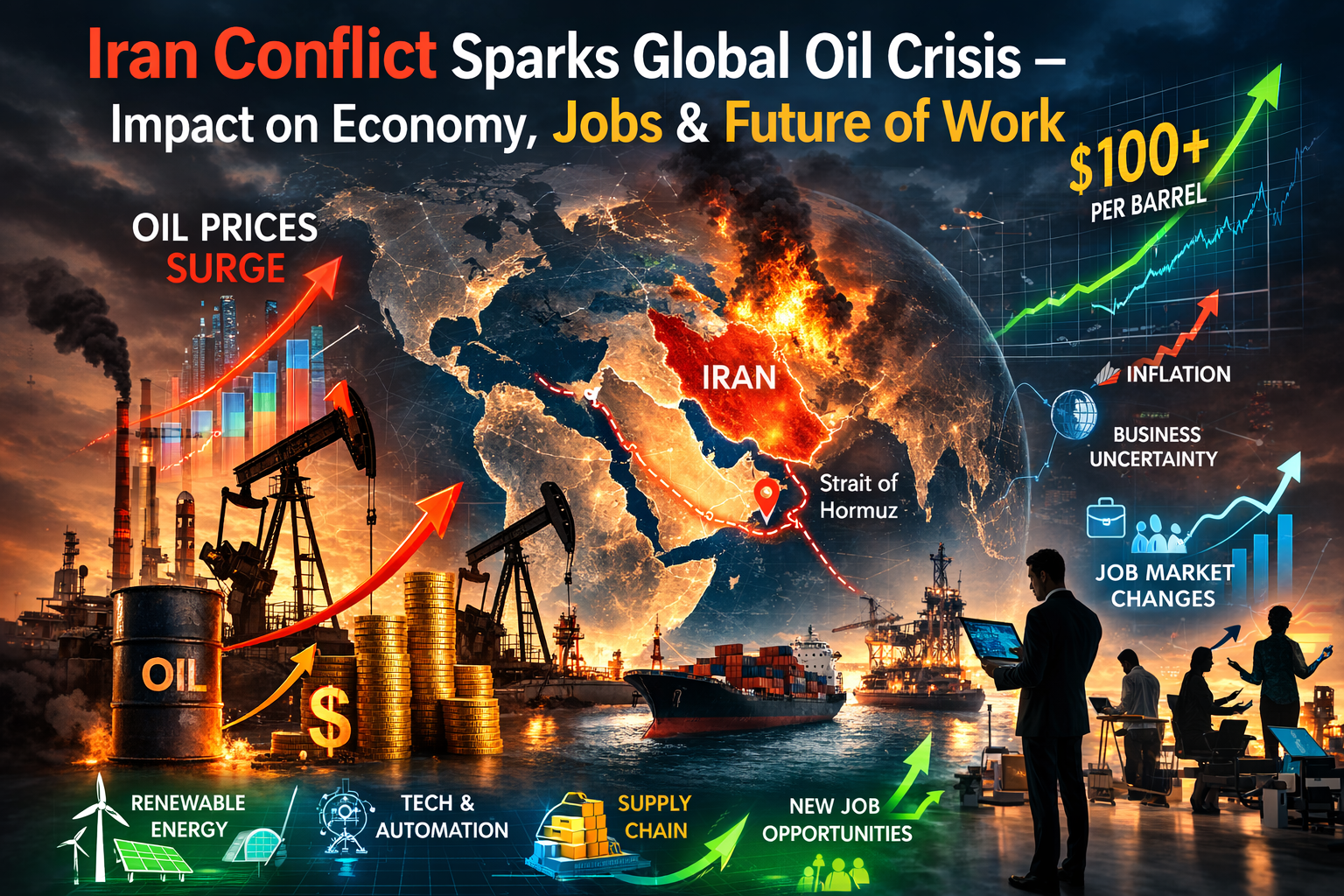

The escalating conflict involving Iran is sending shockwaves through global energy markets and creating economic uncertainty across the world. As oil prices surge and supply routes face disruptions, the consequences are reaching far beyond geopolitics—affecting businesses, employment trends, and future career opportunities.
For job seekers and employers alike, the crisis highlights how global events can rapidly reshape the job market and economic landscape.
One of the main reasons the conflict has such a strong economic impact is the strategic importance of the Middle East in global energy supply. A significant portion of the world’s oil passes through the Strait of Hormuz, a narrow waterway near Iran that handles roughly 20% of global oil consumption. Any disruption in this region immediately drives up oil prices and energy costs worldwide.
Since the escalation of the conflict, oil prices have surged significantly, with benchmark crude prices rising above $100 per barrel in global markets.
In response to market instability, the International Energy Agency announced a coordinated release of more than 400 million barrels of oil from emergency reserves to stabilize global supply and calm energy markets.
Despite these measures, analysts warn that prolonged instability could keep oil prices high, increasing economic pressure across multiple sectors.
Higher oil prices affect businesses in several ways. Energy costs directly influence transportation, manufacturing, and logistics expenses. When fuel prices increase, companies must either absorb higher costs or pass them on to consumers.
This ripple effect often leads to:
Increased inflation
Reduced consumer spending
Slower business expansion
Delayed hiring plans
Economists warn that oil price shocks can also reduce household disposable income because people spend more on fuel and essential goods, leaving less money for other purchases.
Financial markets have already reacted to the geopolitical crisis. For example, stock markets in several countries have experienced volatility, and in India alone investors saw nearly $240 billion in market value erased within a week due to panic selling linked to the conflict.
Economic uncertainty often translates into changes in hiring patterns. During periods of rising costs and inflation, companies may take a more cautious approach to recruitment.
Industries that are heavily dependent on fuel and transportation—such as aviation, logistics, manufacturing, and travel—may face financial pressure if energy prices remain elevated.
Potential impacts on employment include:
Slower hiring growth
Recruitment freezes in some sectors
Increased focus on cost efficiency and automation
Greater demand for skilled professionals in strategic sectors
However, economic disruption also creates opportunities in emerging industries.
While some industries struggle with higher costs, others may experience growth due to the changing global energy landscape.
Sectors likely to see increased demand include:
Renewable Energy and Sustainability
Governments and companies may accelerate investments in renewable energy to reduce reliance on volatile oil markets.
Energy Security and Infrastructure
Countries may invest more in domestic energy production and energy infrastructure.
Technology and Automation
Businesses seeking to reduce operational costs may adopt digital tools, artificial intelligence, and automation.
Supply Chain and Logistics Innovation
Companies will increasingly look for experts who can optimise supply chains and manage global disruptions.
These trends highlight why adaptable skills and digital expertise are becoming increasingly valuable in the modern workforce.
For employers, the current crisis reinforces the importance of flexible hiring strategies and resilient workforce planning.
Organizations may need to:
Prioritise critical hiring roles
Invest in technology-driven recruitment
Focus on productivity and innovation
Strengthen risk management and supply chain strategies
Employers that can adapt quickly to economic shifts are more likely to maintain growth and competitiveness.
For professionals and students planning their careers, global economic disruptions provide an important lesson: job markets are influenced by international events.
Job seekers can improve their long-term career prospects by focusing on:
Skills in technology and digital transformation
Data analytics and AI-related fields
Renewable energy and sustainability roles
Supply chain management and global logistics
Staying informed about economic and geopolitical developments can also help individuals make smarter career decisions.
The Iran conflict demonstrates how closely interconnected the global economy has become. Energy prices, geopolitical tensions, and financial markets can influence business strategies and employment opportunities within weeks.
For employers, the priority is navigating economic uncertainty while maintaining productivity. For job seekers, the key is developing adaptable skills that remain valuable even during global disruptions.
As the world responds to the evolving energy crisis, the future of work will increasingly be shaped by resilience, innovation, and the ability to adapt to change.
ABC News – Political consequences of Iran war and fuel markets
https://www.abc.net.au/news/2026-03-15/political-consequences-iran-fuel-labor-coalition-chris-bowen/106436198
ABC News – Impact of the Iran war on fuel supply and Australian economy
https://www.abc.net.au/news/2026-03-15/how-iran-war-fuel-issues-are-impacting-western-australia/106433076
ABC News – International Energy Agency releasing oil reserves
https://www.abc.net.au/news/2026-03-12/iea-oil-reserves-release-as-ships-hit-in-strait-of-hormuz/106444242
Reuters – Oil markets brace for volatility due to Iran conflict
https://www.reuters.com/markets/commodities/energy/iran-war-oil-markets-brace-wild-price-swings-2026-03-13/
Reuters – Australia moves to ease fuel supply risk from Iran war
https://www.reuters.com/business/energy/australia-races-ease-fuel-supply-iran-war-brings-shortage-risk-2026-03-13/
The Guardian – Middle East war disrupting global oil markets
https://www.theguardian.com/business/2026/mar/12/middle-east-war-creating-largest-supply-disruption-in-the-history-of-oil-markets
The Guardian – Oil prices rise after strikes on Iran’s Kharg Island oil hub
https://www.theguardian.com/world/2026/mar/16/oil-prices-rise-after-trump-claims-us-totally-demolished-irans-vital-kharg-island-export-hub
Reuters – International Energy Agency releasing emergency oil stockpiles
https://www.reuters.com/business/energy/emergency-stockpile-oil-coming-soon-iran-wracked-markets-iea-says-2026-03-15/