

Geelong, Australia
30 January 2026 | 6:05 PM AEDT
Editor: Shubham
Published by: SearchTalents.co Workforce & Economy Desk
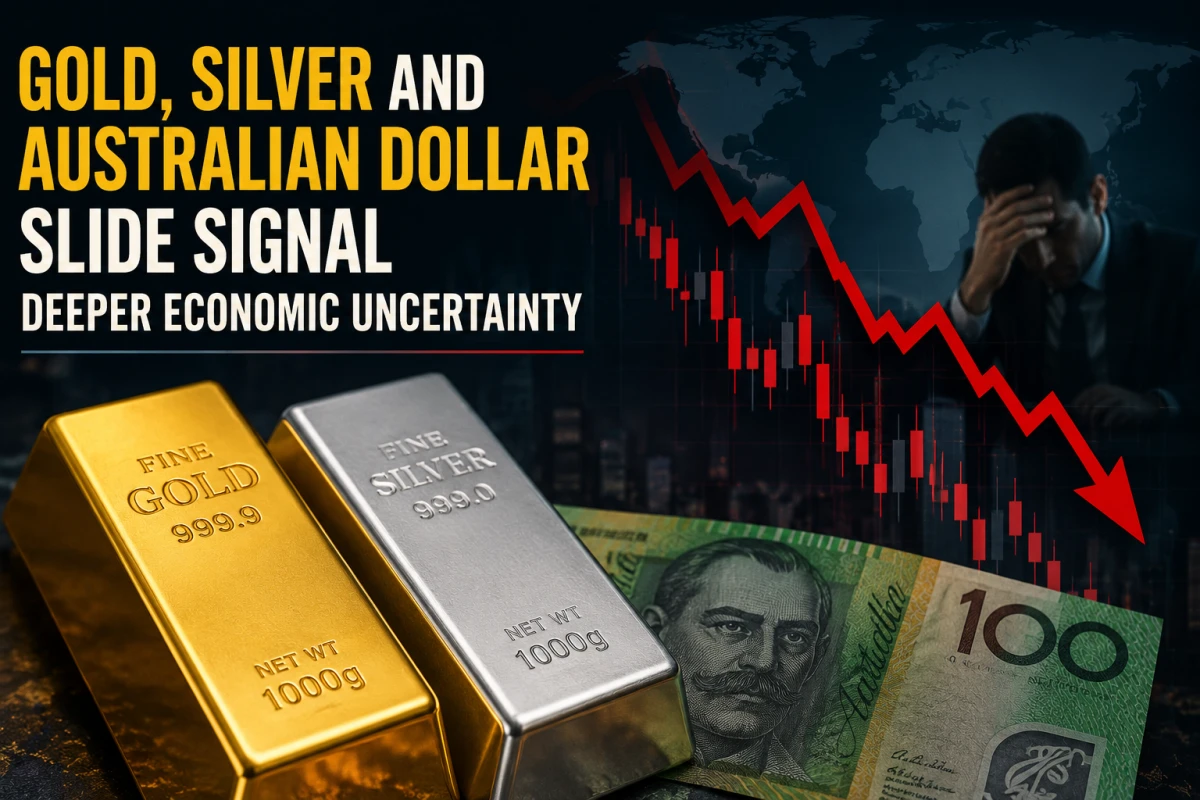
Global financial markets witnessed sharp volatility as gold and silver prices fell steeply alongside a weakening Australian dollar, raising fresh questions about economic stability and future workforce conditions.
According to a report by The Times of India, the sudden crash in precious metals was driven by profit booking, currency movements, and shifting global sentiment during one of the most volatile trading sessions in recent months.
Reference:
https://timesofindia.indiatimes.com/business/india-business/brutal-selloff-gold-silver-prices-crash-in-exceptionally-volatile-session-whats-causing-the-sudden-dip/articleshow/127793760.cms
Adding to the uncertainty, a widely circulated financial news video reported that gold, silver, and the Australian dollar declined simultaneously as markets reacted to political and monetary signals from the United States.
Video source:
https://www.youtube.com/watch?v=N3_SSFfLWtQ
Markets reacted strongly to uncertainty surrounding future leadership at the US Federal Reserve, following indications that former US President Donald Trump may soon announce his preferred candidate for the role. Such signals directly affect expectations around interest rates, inflation control, and global capital movement.
SearchTalents.co analysts observe that uncertainty in global monetary leadership often acts as an early warning sign for economic slowdown, which later impacts business hiring decisions and workforce expansion plans.
The fall in the Australian dollar alongside declining metals prices reflects reduced investor confidence. For Australia, currency weakness can raise import costs, pressure business margins, and slow recruitment activity, particularly in trade and commodity-linked sectors.
From a workforce perspective, SearchTalents.co notes that employers often delay hiring and prioritise cost efficiency during such periods.
While gold and silver are financial assets, their sharp decline highlights a broader reality. Economic stability is fragile, and assumptions about safety can be misleading.
SearchTalents.co workforce trend data indicates that during volatile economic cycles, demand shifts toward adaptable professionals, cross-functional skills, and roles that directly support business continuity.
SearchTalents.co considers the current market movement a signal rather than a one-off event. Financial markets often react first, while employment trends follow with a delay.
Professionals who track economic indicators, continuously upgrade skills, and remain flexible are better positioned to withstand uncertainty. Employers who align hiring strategies with real market signals maintain long-term resilience.
For workforce insights, verified job opportunities, and labour market analysis, visit:
https://searchtalents.co