
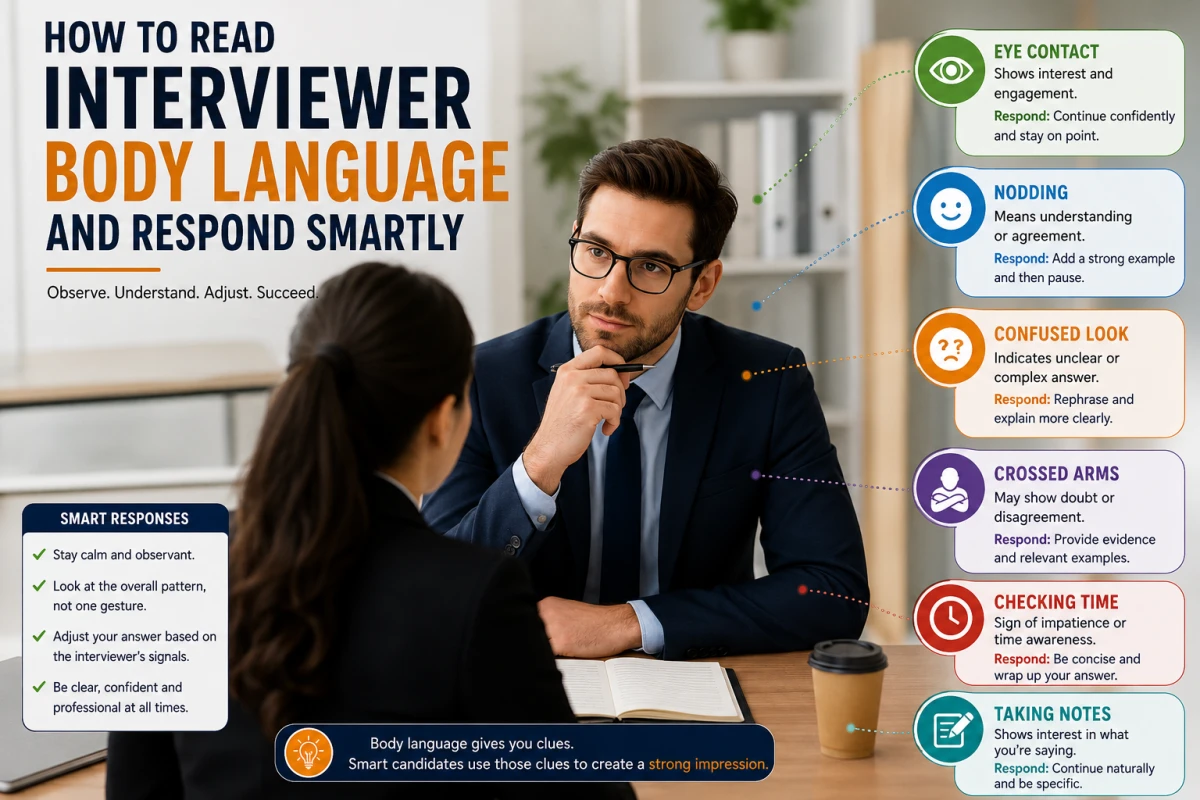
A job interview is not only about answering questions correctly. It is also about understanding the interviewer, reading the situation and responding in a way that makes you look confident, prepared and professional. Many candidates focus only on what they are going to say, but smart candidates also pay attention to how the interviewer is reacting.
Body language can give you useful clues during an interview. The interviewer may not always say, “Your answer is too long,” “I need more clarity,” or “That was a good example.” Instead, they may show it through their facial expressions, eye contact, posture, gestures or tone. If you learn to notice these signals, you can adjust your answers and handle the interview more smartly.
However, it is important to remember that body language is not always 100% accurate. One gesture alone does not tell the full story. For example, crossed arms may show doubt, but they may also simply mean the interviewer is sitting comfortably. Looking at the clock may mean they are bored, but it may also mean they have another meeting soon. The key is to observe the overall pattern, not just one small action.
In an interview, communication happens in two ways: verbal and non-verbal. Verbal communication includes questions, answers and spoken feedback. Non-verbal communication includes facial expressions, posture, eye contact, nodding, gestures and silence.
When you understand these non-verbal signs, you can respond better. If the interviewer looks interested, you can add a strong example. If they look confused, you can explain your answer more clearly. If they seem rushed, you can keep your response short. If they look doubtful, you can support your answer with evidence.
This skill shows emotional intelligence. It tells the interviewer that you are not just speaking blindly, but you are aware of the conversation. In the workplace, this matters because employees need to read situations, understand people and communicate professionally.
Good eye contact usually shows that the interviewer is listening carefully. If they are looking at you naturally, nodding and staying focused, it means your answer is probably relevant.
In this situation, continue with confidence. Keep your answer structured and do not go off-topic. You can use this moment to add one useful example that supports your point.
For example, if the interviewer asks about teamwork and they seem interested, you can say:
“During my college project, I worked with a team of five people. We divided the work clearly, supported each other and completed the project before the deadline. That experience helped me understand the importance of communication and responsibility.”
This kind of answer is clear and practical. It also shows that you can explain your experience with confidence.
Sometimes the interviewer may stop nodding, look at your resume again, tilt their head slightly or ask the same question in another way. This may mean your answer was not clear enough.
Do not panic if this happens. Many candidates become nervous and start speaking faster, which makes the answer even more confusing. Instead, slow down and simplify your explanation.
You can say:
“Let me explain that more clearly.”
Or:
“A better way to say it is…”
This shows that you are calm and aware. It also tells the interviewer that you can correct yourself professionally. Employers appreciate candidates who can explain ideas clearly, especially in roles where communication is important.
Nodding is usually a positive sign. It may mean the interviewer understands your answer or agrees with your point. But this does not mean you should keep talking for too long.
Many candidates make the mistake of over-explaining when they see a positive reaction. They think the interviewer is very interested, so they continue adding more and more details. This can weaken a good answer.
The smart approach is to add one strong point and then stop. A short answer with a relevant example is much better than a long answer with unnecessary details.
For example:
“That experience improved my confidence because I had to speak with different team members and manage deadlines. It also helped me become more responsible.”
This keeps the answer focused and professional.
A serious face does not always mean something is wrong. Some interviewers naturally keep a formal expression. They may be listening carefully, taking notes or thinking about your answer.
If the interviewer looks serious, do not assume that you have failed. Stay calm. Focus on answering the question directly. Keep your tone polite and confident.
If they ask a follow-up question, treat it as a chance to explain better. You can say:
“Yes, I understand your point. Let me give you a practical example.”
This kind of response shows maturity. It tells the interviewer that you do not become nervous under pressure.
Crossed arms can sometimes show doubt, disagreement or lack of openness. But it can also simply be a comfortable sitting position. So do not judge too quickly.
Look at the complete body language. If the interviewer has crossed arms, less eye contact, short replies and a serious tone, they may not be fully convinced by your answer. In that case, give evidence instead of repeating the same point.
For example, instead of saying, “I am hardworking,” say:
“In my internship, I was given a task with a short deadline. I planned the work, asked questions where needed and completed it on time. That helped me understand how to work under pressure.”
Evidence makes your answer stronger. It is always better to show your quality through an example instead of just claiming it.
If the interviewer checks the clock, looks at their screen repeatedly or seems ready to move to the next question, your answer may be too long. It may also mean they are running out of time.
In this situation, shorten your response. Do not continue explaining every detail. Finish your point clearly and connect it to the role.
You can say:
“To keep it short, that experience helped me improve my time management and communication skills, which I believe are important for this role.”
This shows that you respect the interviewer’s time. It also shows that you can communicate in a focused way.
If the interviewer starts writing notes while you are speaking, it can be a good sign. They may have found something important in your answer. They may also be noting points for later discussion.
Do not stop speaking suddenly or become uncomfortable. Continue naturally. Make sure your answer is honest because the interviewer may ask a follow-up question based on what they wrote.
This is a good time to speak clearly about your achievements, skills, projects, internships or responsibilities. Keep your points specific and easy to understand.
Silence can feel uncomfortable in an interview. Many candidates immediately start talking again because they think silence means their answer was bad. But silence does not always mean something negative.
The interviewer may be thinking, reading your resume, writing notes or preparing the next question. So do not rush to fill every pause.
Stay calm and wait for a moment. If the silence feels long, you can politely ask:
“Would you like me to explain that in more detail?”
This is a smart response because it gives control back to the interviewer and shows that you are confident.
A smile is usually a positive signal. It may show that the interviewer feels comfortable with your answer or likes your attitude. But you should still remain professional.
Smile naturally, maintain calm eye contact and continue with your answer. Do not become too casual or start speaking like it is a friendly conversation. Remember that it is still a professional interview.
A positive reaction is a good opportunity to strengthen your answer, not to lose focus.
Reading body language is useful, but your response matters more. If the interviewer looks interested, add a strong example. If they look confused, explain simply. If they look doubtful, give proof. If they look rushed, keep it short. If they smile or nod, stay confident but professional.
The best candidates are flexible. They do not give memorised answers like a script. They observe the interviewer and adjust their communication according to the situation.
Interviewer body language can help you understand how your answers are being received. It can guide you to speak with more clarity, confidence and awareness. But it should not make you overthink every small movement.
Focus on the overall behaviour of the interviewer, not one single gesture. Stay calm, listen carefully and respond with balance. When you can read the room and adjust your answers smartly, you show strong communication skills, emotional intelligence and professional confidence.
In the end, interviews are not only about giving perfect answers. They are about building trust, showing clarity and proving that you can handle real workplace conversations. A candidate who can observe, understand and respond smartly will always create a stronger impression.
HelpGuide — Body Language and Nonverbal Communication
https://www.helpguide.org/relationships/communication/nonverbal-communication
HelpGuide — Effective Communication: Improving Your Interpersonal Skills
https://www.helpguide.org/relationships/communication/effective-communication
Harvard Business Review — When Giving Critical Feedback, Focus on Your Nonverbal Cues
https://hbr.org/2017/01/when-giving-critical-feedback-focus-on-your-nonverbal-cues
Harvard Business Review — Nonverbal Cues Get Employees to Open Up—or Shut Down
https://hbr.org/2015/12/nonverbal-cues-get-employees-to-open-upor-shut-down-2
Verywell Mind — 7 Active Listening Techniques For Better Communication
https://www.verywellmind.com/what-is-active-listening-3024343
Verywell Mind — How to Read Mixed Signals in Body Language
https://www.verywellmind.com/how-to-read-mixed-signals-8719556
Verywell Mind — 10 Tips for Improving Your Nonverbal Communication
https://www.verywellmind.com/top-nonverbal-communication-tips-2795400
National Career Development Association — Nonverbal Communication Strategies in Interviews
https://ncda.org/aws/NCDA/pt/sd/news_article/384027/_PARENT/CC_layout_details/false