
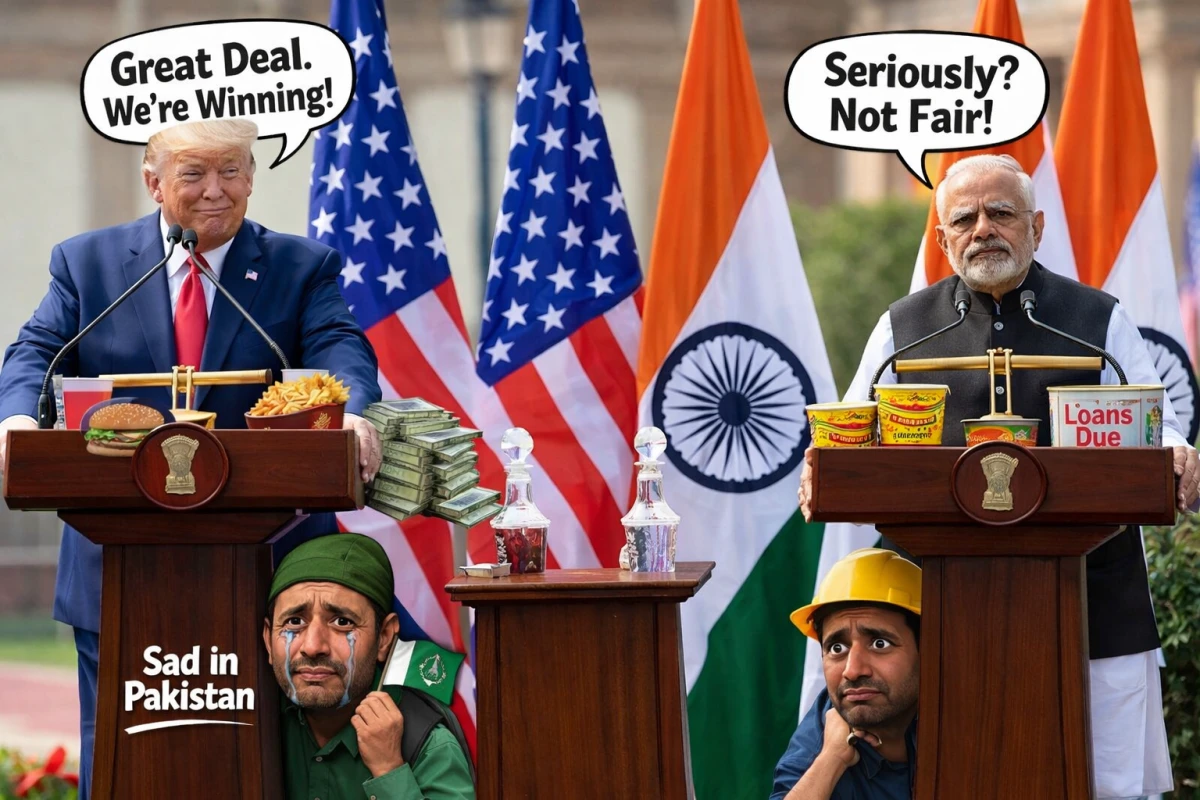

The recent India–US trade deal has triggered strong reactions across South Asia. While India secured reduced tariff access to the US market, the outcome has led to visible domestic criticism within Pakistan, where commentators questioned the effectiveness of their own diplomatic and economic strategy.
According to NDTV, Pakistani critics openly stated that symbolic diplomacy failed to deliver tangible trade benefits, especially when compared to India’s outcome. The debate highlights how economic leverage, not political optics, increasingly defines global trade relationships.
For India, however, the agreement is being seen as a forward-looking economic signal with direct implications for businesses, hiring, and workforce planning.
Under the agreement, the United States reduced tariffs on several Indian exports to around 18 percent, improving India’s competitiveness in the US market. This development is expected to support growth in export-driven industries and strengthen investor confidence.
Markets reacted positively to the announcement, reinforcing the idea that trade policy can directly influence economic momentum and employment demand.
The backlash in Pakistan is not just political commentary. It reflects a broader regional shift where countries with stronger production capacity, stable trade frameworks, and skilled workforces gain preference in global supply chains.
The core lesson is clear: international trade success depends on economic readiness, not public posturing. For professionals and businesses, this reinforces the importance of real skills, scalable operations, and compliance with global standards.

For employers, the trade deal presents an opportunity to expand operations linked to US markets. Sectors likely to see increased hiring include:
Manufacturing and export-oriented industries
Pharmaceuticals and chemicals
IT services supporting global clients
Logistics, supply chain, and trade compliance
International sales and business development
Employer insight: Companies planning export growth should align hiring strategies now. Posting roles connected to US market expansion on SearchTalents.co can attract candidates with relevant international exposure and technical skills.
Trade deals do not create jobs overnight, but they reshape demand. Students and professionals who align their skills with global trade requirements gain a clear advantage.
High-value skills include:
Trade documentation and compliance knowledge
Supply chain coordination
Data analysis and forecasting
Cross-border communication skills
International client management
Career advice: Candidates who understand how global trade affects business operations stand out in interviews and long-term career growth.
SearchTalents.co connects hiring trends with real-world economic developments. The India–US trade deal and Pakistan’s response highlight how global policy decisions influence workforce demand, employer confidence, and career direction.
For employers, it is a signal to prepare for expansion.
For students and job seekers, it is a reminder that skills aligned with global markets create resilience.
🔗 You Can’t Buy Respect: Pakistan Faces Domestic Backlash After India-US Trade Deal
https://www.ndtv.com/world-news/you-cant-buy-respect-pakistan-faces-domestic-backlash-after-india-us-trade-deal-10948352
🔗 US Lowers Tariffs On Indian Exports To 18%: Where Other Countries Stand
https://www.ndtv.com/world-news/india-us-trade-deal-us-lowers-tariffs-on-indian-exports-to-18-where-other-countries-stand-10935733