The debate around artificial intelligence and jobs has dominated headlines for the past few years. Graduates have been warned that AI could automate junior tasks, reduce entry-level opportunities and make starting a professional career more difficult.
But new research suggests another major workplace change deserves just as much attention: remote and hybrid work.
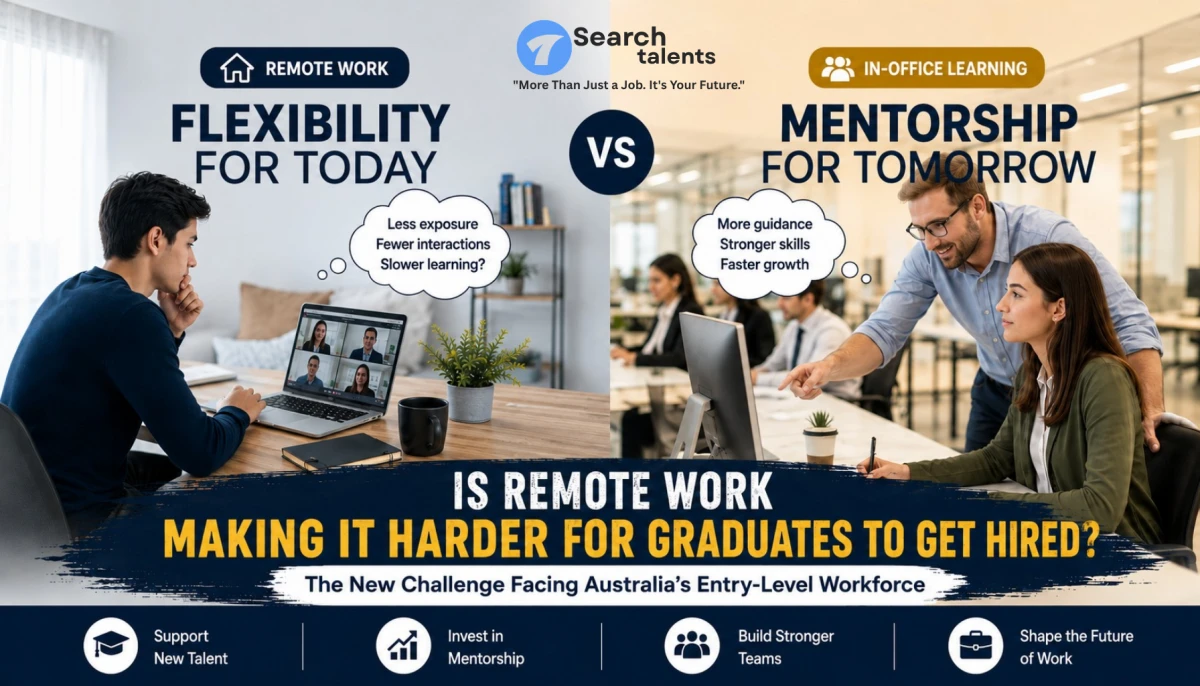
A large international study examining hundreds of millions of hiring records and online job advertisements across Australia, the United Kingdom, the United States and Canada found that the decline in early-career hiring is more closely associated with the rise of remote work than with exposure to generative AI when both factors are considered together.
That does not mean working from home is bad, nor does it mean companies should abandon flexible work. It raises a more important question for Australian employers and job seekers:
Has the way we work changed faster than the way we train the next generation of workers?
For graduates, students and employers, the answer could have major implications.
Entry-level employment has traditionally served as the first step between education and a long-term professional career.
Graduates enter junior positions, learn from experienced colleagues, gradually take on more responsibility and eventually progress into more senior roles.
That process depends on much more than completing assigned tasks.
Early-career employees learn by observing how experienced colleagues communicate with clients, manage deadlines, solve unexpected problems, negotiate priorities and make professional decisions.
Some of this knowledge can be documented in training material. Much of it cannot.
It develops through everyday workplace interaction.
When organisations moved rapidly towards remote and hybrid work, experienced employees were often able to continue performing effectively because they already understood their jobs, industries and professional expectations.
A new graduate entering the workforce does not necessarily have that advantage.
Generative AI is frequently blamed for declining entry-level opportunities because many junior roles involve tasks such as research, basic analysis, drafting, administration and information processing.
However, researchers Peter John Lambert and Yannick Schindler examined 243 million new hires and 407 million online job advertisements across Australia, the US, UK and Canada.
Their research found that both AI exposure and work-from-home exposure initially appeared connected with declining junior hiring.
But when the two were analysed together, the association with remote work remained much stronger, while the estimated AI effect became significantly weaker.
Their broader policy analysis found that by 2025 the share of new hires going to early-career workers across the four countries was around 8% to 11% below 2019 levels.
The researchers are careful not to argue that businesses should simply force employees back into offices.
Instead, their findings highlight a structural problem: flexible working arrangements may need to be redesigned so that junior employees still receive the training, mentoring and professional exposure required to develop.
Consider two employees working remotely.
The first has eight years of industry experience. They understand workplace expectations, know when to ask questions, have established professional networks and can usually identify problems independently.
The second graduated three months ago.
They may understand the theory behind the job but still be learning how a professional organisation actually operates.
A message saying “please prepare this for the client” could be straightforward for the experienced employee.
For the graduate, it may generate several questions:
In an office, many of these questions can be answered through quick conversations and observation.
In a poorly designed remote environment, the graduate may hesitate to schedule another video call or send repeated messages.
That small difference can significantly affect learning over time.
There is another possible consequence.
If managers believe junior employees require more supervision in remote environments, hiring someone who already has two or three years of experience may feel easier than training someone from the beginning.
For one position, that decision may appear completely rational.
Across thousands of businesses, however, the same behaviour could gradually reduce the number of genuine entry-level opportunities available.
It can also create the familiar problem facing many graduates:
“How can I get experience when every job already requires experience?”
This is why entry-level hiring is not simply a graduate issue.
Businesses also need a sustainable pipeline of future supervisors, specialists, managers and leaders.
If organisations stop developing junior talent today, they may face much larger capability shortages later.
It would be too simplistic to conclude that remote work should disappear.
Flexible working can provide significant advantages.
Employees can reduce commuting time, businesses can recruit beyond their immediate geographic area, parents and carers may receive greater flexibility, and organisations can access talent that may otherwise be unavailable.
The problem is not necessarily flexibility itself.
The problem is assuming that the same work model works equally well for every stage of a person's career.
An experienced professional may need autonomy.
A new graduate may need autonomy plus structured development.
Employers therefore need to consider career stage when designing hybrid arrangements rather than applying exactly the same approach to every employee.
The solution does not have to be five mandatory office days.
Employers can make hybrid work much more useful for junior employees by making learning deliberate rather than accidental.
For example, organisations can:
The important point is that simply bringing a graduate into an office does not automatically create development.
A graduate sitting alone at a desk while everyone else attends online meetings receives little benefit.
Presence is not the same as mentorship.
Graduates also need to adapt to the changing workplace.
When evaluating an opportunity, salary and job title are important, but the learning environment should matter as well.
Ask questions during interviews such as:
These questions can reveal much more about the value of an entry-level position than whether it offers two or three work-from-home days.
Graduates working remotely should also become intentional about visibility.
Do not wait until something goes wrong before communicating with a manager.
Share progress, ask focused questions, request feedback and build professional relationships across the organisation.
Remote workers can still develop strong networks, but those connections usually need to be created deliberately.
There is a broader lesson for employers.
A graduate role should not simply exist because a company needs someone to complete low-level administrative tasks.
AI will continue automating some of those tasks.
The strongest entry-level programs will therefore focus on developing capabilities that become more valuable over time: judgement, communication, commercial awareness, problem solving, relationship building and industry knowledge.
Instead of asking:
“What basic tasks can this graduate perform?”
Employers should ask:
“What professional could this person become in three years if we train them properly?”
That changes the economics of graduate hiring.
Training becomes an investment in future organisational capability rather than an immediate productivity calculation.
Australia continues to have significant recruitment activity even as hiring conditions vary between industries and regions.
Jobs and Skills Australia reported that its latest recruitment research shows employers are still actively recruiting, while recruitment difficulty remains particularly high in some industries and occupations.
This makes developing junior talent even more important.
Businesses cannot permanently solve skills shortages by competing for the same pool of experienced professionals.
At some point, somebody has to create the experienced workers businesses want to hire.
Graduate programs, apprenticeships, internships and genuine entry-level roles are part of that pipeline.
Employers that build strong development systems today may therefore have an important competitive advantage tomorrow.
The future of work does not need to become a choice between full-time office work and completely remote employment.
Nor should every decline in entry-level hiring automatically be blamed on artificial intelligence.
The bigger challenge is designing workplaces where flexibility and professional development can exist together.
For employers, that means creating intentional mentoring, meaningful training and genuine career pathways.
For graduates, it means looking beyond the job title and choosing organisations where they can learn, contribute and grow.
Technology will keep changing.
Workplaces will keep changing.
But every organisation will still need experienced people in the future.
Those experienced professionals have to start somewhere.
Platforms such as SearchTalents.co can help connect employers looking for emerging talent with job seekers searching for opportunities to begin and build their careers.
The question for Australian businesses is no longer simply whether remote work should stay.
It is whether the career ladder can evolve with it.
University of Warwick – Remote Work, AI & Early-Career Hiring Research
https://warwick.ac.uk/fac/soc/economics/research/centres/cage/news/17-06-26-new_research_shows_that_remote_work_not_ai_is_linked_to_declining_early_career_hiring/
Research shows remote/hybrid work is strongly associated with the decline in early-career hiring across Australia, UK, US and Canada.
University of Warwick – The Broken Ladder Policy Briefing
https://warwick.ac.uk/fac/soc/economics/research/centres/cage/publications/policybriefings/2026/the_broken_ladder_remote_work_ai_and_the_decline_in_early_career_hiring/
Useful for the blog sections about mentoring, training and redesigning hybrid work for junior employees.
University of Warwick – Full Working Paper
https://warwick.ac.uk/fac/soc/economics/research/centres/cage/publications/workingpapers/2026/the_broken_ladder_ai_remote_work_and_early_career_hiring/
The study analyses 243 million new hires and 407 million job advertisements, including Australian data.
Jobs and Skills Australia – Recruitment Experiences and Outlook Survey
https://www.jobsandskills.gov.au/data/recruitment-experiences-and-outlook-survey/spotlight-articles
Good Australian government source for current employer recruitment activity and hiring difficulty.
QILT – Graduate Outcomes Survey 2025
https://www.qilt.edu.au/surveys/graduate-outcomes-survey-%28gos%29
Useful for Australian graduate employment statistics. QILT reports a 75.4% undergraduate full-time employment rate in 2025 under its updated labour-force definition.
Australian Bureau of Statistics – Labour Force, Australia, July 2026
https://www.abs.gov.au/statistics/labour/employment-and-unemployment/labour-force-australia/jul-2026
#RemoteWork #HybridWork #GraduateJobs #EntryLevelJobs #AustralianJobs #GraduateCareers #JobSearchAustralia #FutureOfWork #CareerDevelopment #GraduateEmployment #HiringTrends #EmployerInsights #WorkplaceMentoring #AustralianJobMarket #SearchTalents