
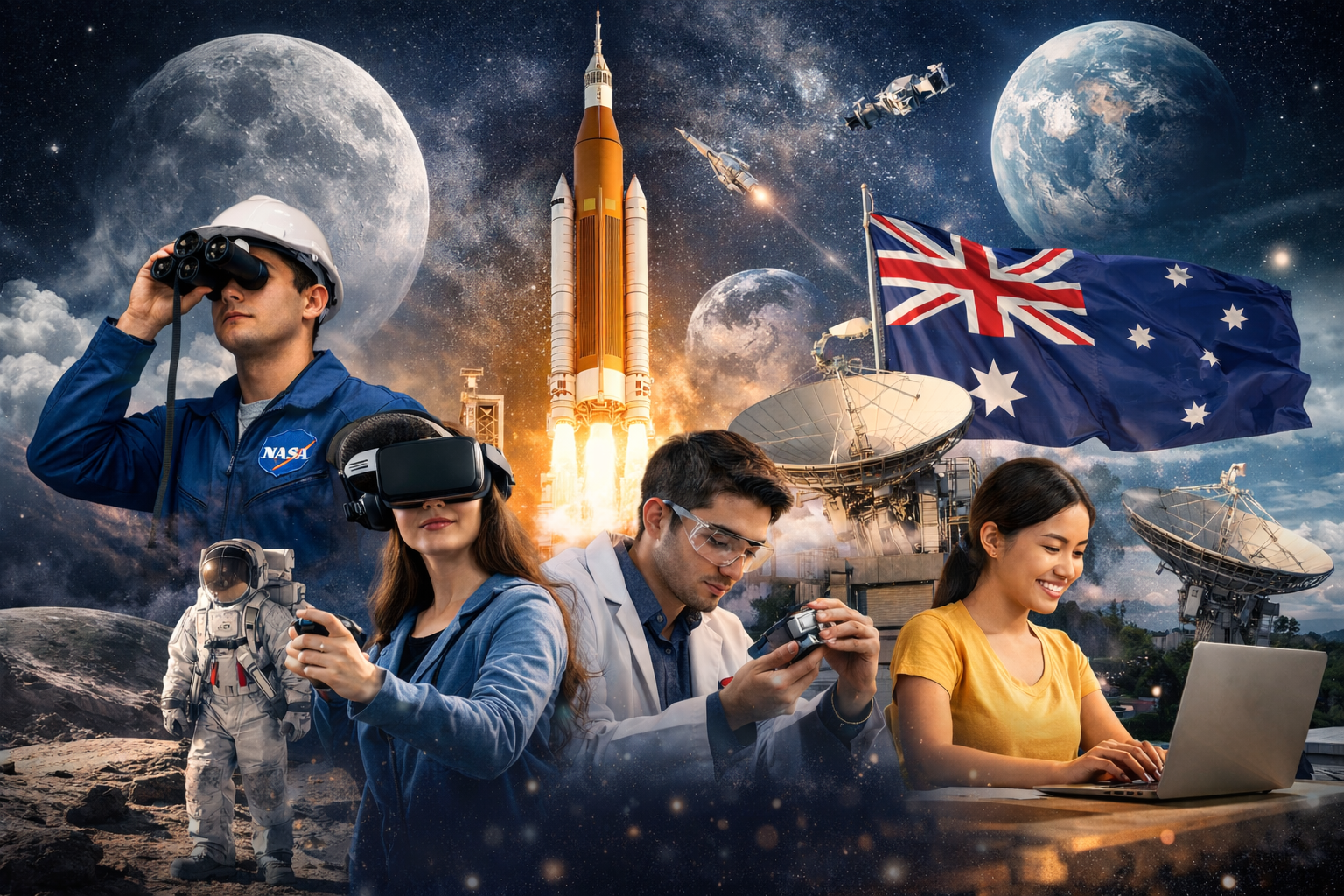

The world is once again witnessing a historic moment in space exploration. With NASA preparing for its Artemis II mission — a crewed journey around the Moon — global attention has shifted beyond just science and discovery. This mission is not only about space; it is about the future of careers, innovation, and global collaboration.
Interestingly, Australia is playing a crucial role in this mission, highlighting how countries across the world are contributing to space exploration. For students and jobseekers, this is more than news — it is a clear signal of where future opportunities are heading.
As NASA advances toward sending astronauts around the Moon, Australia is supporting the mission through advanced ground-based infrastructure and communication technologies.
Facilities such as NASA’s Deep Space Network, managed with Australian support, help maintain constant communication with spacecraft traveling millions of kilometres away from Earth. Additionally, Australian researchers and engineers are contributing to innovations like laser communication systems, which allow faster and more reliable data transmission in space missions.
This collaboration demonstrates how global expertise is essential in modern scientific achievements.
For students planning their future careers, this mission provides a clear direction — the future belongs to innovation-driven industries.
There is a growing demand for skills in:
Even beyond technical roles, areas such as project management, research coordination, and international relations are becoming increasingly important in global missions.
Students should focus on building adaptable, future-ready skills that align with these industries.
For jobseekers, the Artemis II mission highlights an important shift in the global job market.
As governments and private organisations invest heavily in space and advanced technologies, new employment opportunities are emerging across multiple sectors.
Key trends include:
This means jobseekers must stay updated with evolving industry trends and continuously upgrade their skills to remain competitive.
One of the most important takeaways from this mission is the power of international collaboration.
NASA’s Artemis II mission is not limited to the United States. Countries like Australia are actively contributing, proving that future careers will increasingly involve working across borders.
This opens doors for:
Professionals who can adapt to global work environments will have a strong advantage in the future job market.
If you are a student or jobseeker, this is the right time to take action:
The future workforce will not be defined by traditional roles but by innovation, adaptability, and global collaboration.
NASA’s Artemis II mission represents more than a return to the Moon — it reflects the direction of the global economy and job market.
With Australia playing a key role, this mission highlights how opportunities are expanding beyond borders. For students and jobseekers, it is a strong reminder that the careers of tomorrow will be shaped by technology, collaboration, and continuous learning.
Those who prepare today will be the ones leading tomorrow.