
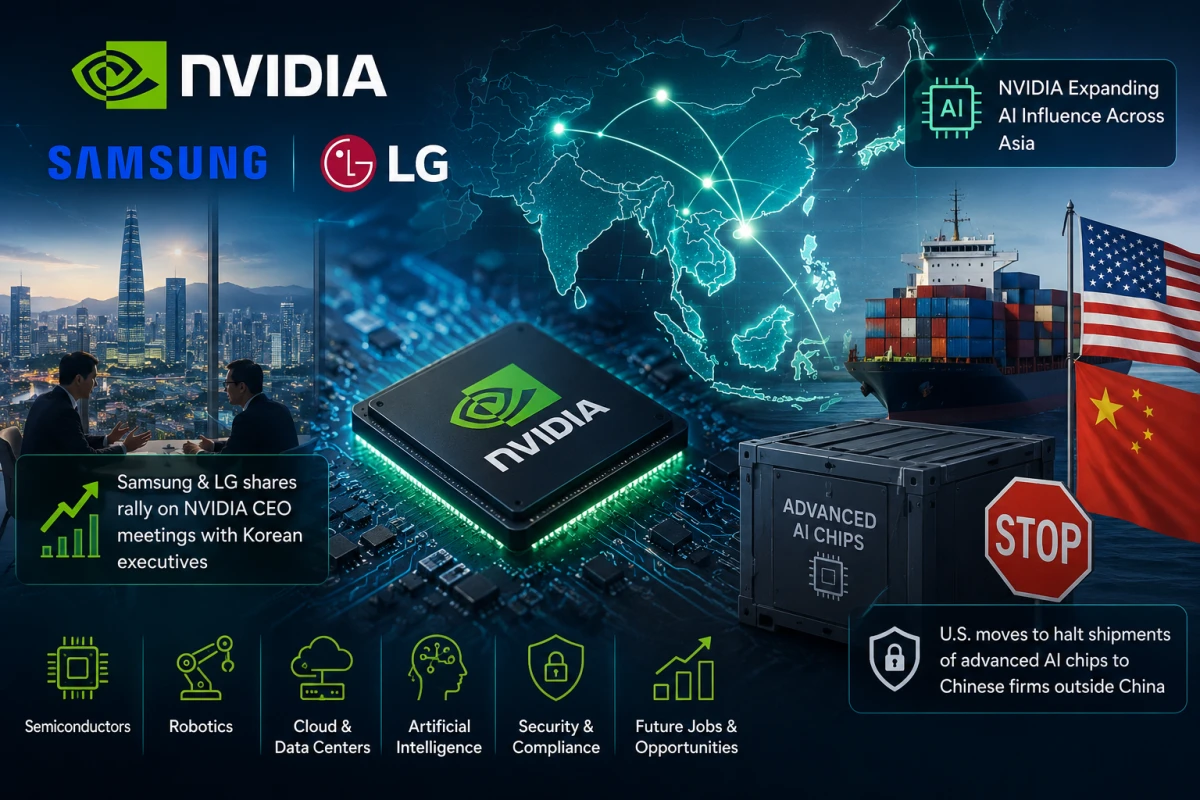

NVIDIA is once again at the centre of global technology news. The semiconductor and AI chip giant is expanding its influence across Asia, while major companies and governments are paying close attention to how artificial intelligence hardware will shape the future economy.
Recent reports show two important developments. First, shares of major South Korean technology companies such as Samsung Electronics and LG Electronics rallied as investors expected meetings between NVIDIA CEO Jensen Huang and Korean executives, raising hopes for stronger AI and robotics partnerships. Second, the U.S. Department of Commerce moved to enforce export licence requirements for advanced AI chips going to Chinese firms located outside China, aiming to close a possible loophole in chip exports.
For normal readers, this may look like stock market or semiconductor industry news. But for job seekers, students, employers and recruiters, this update carries a much bigger message: AI infrastructure, semiconductor supply chains, robotics and advanced computing are becoming major career growth areas.
For platforms like SearchTalents.co, this news is highly relevant because it shows where future job demand may grow and what skills candidates should start building now.
NVIDIA’s influence in Asia is growing because the company is deeply connected with the AI supply chain. South Korean firms such as Samsung, LG Electronics and SK Hynix are important players in chips, memory, electronics, robotics and AI-related hardware. Reuters reported that Samsung and LG shares rallied as expected meetings between NVIDIA CEO Jensen Huang and Korean executives raised hopes for possible AI and robotics tie-ups.
At the same time, NVIDIA is also focusing heavily on Taiwan and the wider Asian technology ecosystem. NVIDIA’s GTC Taipei at COMPUTEX is showcasing AI platforms, physical AI, AI compute, AI infrastructure, robotics, autonomous machines and partner demos, showing how the company is positioning Asia as a major AI innovation hub.
On the policy side, the U.S. government has taken steps to tighten controls on advanced AI chip shipments to Chinese firms operating outside China. Reuters reported that the Commerce Department issued guidance to enforce licence requirements for advanced chips, including high-end NVIDIA Blackwell processors, when Chinese-headquartered entities are located abroad.
This means the AI chip industry is not only about technology. It is also connected to global trade, national security, supply chains, business strategy and workforce planning.
AI is no longer limited to software companies. It is now connected with chips, data centres, cloud systems, robotics, manufacturing, automotive technology, cybersecurity and advanced engineering.
When a company like NVIDIA expands its influence in Asia, it affects many areas of employment, including:
This is why students and job seekers should not look at AI only as “ChatGPT skills” or basic prompt writing. The bigger AI economy needs people who understand technology, hardware, software, data, business and regulation.
For employers and recruiters, this news shows that hiring demand may continue shifting toward AI-ready talent, technical problem-solvers and candidates who can adapt to fast-changing technology markets.
Job seekers should treat this NVIDIA news as a signal that AI-related career opportunities may continue to grow across different industries.
Companies need people who can work with AI tools, data systems, automation platforms and cloud infrastructure. Even non-technical job seekers should understand how AI is changing business operations.
Useful skills for job seekers include:
A candidate who understands AI at a practical level may stand out more than someone who only has a basic resume with no digital skills.
NVIDIA’s growth is connected to chips, servers, high-bandwidth memory, data centres and AI infrastructure. Reuters reported that Samsung has started shipping samples of its latest high-bandwidth memory chip, a product considered important for AI data centres.
This creates career opportunities beyond software. Job seekers can explore roles in:
Candidates with engineering, IT, electronics or technical backgrounds should watch these sectors closely.
As AI hiring and technology-driven recruitment grow, generic resumes may perform poorly. A resume should clearly show the candidate’s skills, tools, projects and measurable achievements.
A strong tech-focused resume should include:
For example, instead of writing “Interested in AI,” a candidate can write:
“Completed a machine learning project using Python and basic data analysis to identify customer behaviour patterns.”
This is more practical and employer-friendly.
Students should not wait until graduation to prepare for AI-driven careers. NVIDIA’s Asia expansion shows that the future workforce will need people with practical, digital and technical skills.
Students do not need to become AI experts immediately, but they should understand basic AI concepts.
Important areas to learn include:
Students from engineering, IT, business, marketing and management backgrounds can all benefit from AI awareness.
Employers want candidates who can show real work. Students should focus on internships, projects, freelance work, volunteering and portfolio building.
Good project ideas include:
A student with small but practical projects may look stronger than a student who only lists academic qualifications.
This NVIDIA update shows why students should follow technology news, not just exam updates. Global company decisions can affect future hiring, skill demand and internship opportunities.
Students should regularly read about:
SearchTalents.co can help students by publishing simple career-focused explanations of global business and technology news.
Employers should understand that AI is changing both business operations and hiring expectations. Companies that want to attract strong candidates need to become clearer, faster and more skill-focused in recruitment.
AI-related work often needs practical ability. A candidate may not always have a perfect degree, but they may have strong project experience, tool knowledge or problem-solving ability.
Employers should check:
This approach can help companies find better candidates in a competitive market.
If employers want AI-ready candidates, they need to write clear job posts. A vague job post will attract irrelevant applications.
A strong job description should include:
For example, instead of writing:
“We need an AI engineer.”
A better job post would say:
“We are hiring an AI Engineer with Python, machine learning basics, data preprocessing knowledge and experience working with model testing or AI automation tools.”
This helps candidates understand the role and improves application quality.
As AI, robotics, chips and infrastructure sectors grow, skilled candidates may become harder to attract. Employers should improve their branding and hiring process.
They should focus on:
Companies that explain why candidates should join them will have a better chance of attracting serious applicants.
Recruiters will play an important role in connecting AI-ready candidates with employers. But recruitment must become more informed and transparent.
Recruiters do not need to be engineers, but they should understand basic differences between AI-related roles.
For example:
Understanding these roles helps recruiters screen candidates more accurately.
AI and semiconductor jobs can be complex. Recruiters should avoid selecting candidates only because they have one keyword on their resume.
Instead, recruiters should check:
This creates better matches for employers and better experiences for candidates.
Recruiters can build trust by sharing helpful content about AI hiring, resume tips, interview preparation and career paths.
Good recruiter content ideas include:
This type of content can also help SearchTalents.co generate organic traffic.
SearchTalents.co recommends that job seekers, students, employers and recruiters take this NVIDIA news seriously because it reflects a larger shift in global employment.
AI is creating demand not only for software developers but also for hardware experts, data centre professionals, robotics specialists, cloud engineers, cybersecurity teams, product managers and skilled recruiters.
Job seekers should build practical AI and digital skills. Students should start career preparation early through internships and projects. Employers should improve job descriptions and hire for real capability. Recruiters should understand AI job roles and guide candidates with better communication.
The future job market will reward people and companies that can adapt quickly.
NVIDIA’s Asia expansion and the latest AI chip restrictions show that the global technology market is entering a new stage. AI is not just about software tools. It depends on chips, data centres, memory, robotics, cloud infrastructure, supply chains and international rules.
For job seekers, this means future opportunities may grow in AI-related technical and business roles. For students, it means career preparation should begin earlier with practical skills, projects and internships. For employers, it means hiring strategies must become clearer and more skill-focused. For recruiters, it means better role understanding and stronger candidate guidance will be essential.
For SearchTalents.co, this is a strong opportunity to connect global technology news with real career advice. By publishing useful, original and practical hiring insights, SearchTalents.co can help job seekers, students, employers and recruiters understand where the future job market is heading.
1. Reuters — Samsung, LG shares rally ahead of NVIDIA CEO meetings with Korean executives
Use angle: NVIDIA ke Asia expansion se AI, robotics, semiconductor aur tech hiring demand grow ho sakti hai.
2. Reuters — U.S. takes step to halt NVIDIA AI chip shipments to Chinese firms outside China
Use angle: AI chips ab global policy, export controls aur supply chain jobs se bhi connected hain.
3. NVIDIA Official — GTC Taipei at COMPUTEX
Use angle: NVIDIA Asia mein AI platforms, AI infrastructure, physical AI aur robotics ko strongly promote kar raha hai.
4. Reuters — NVIDIA CEO to kick off and dominate COMPUTEX gathering in Taipei
Use angle: NVIDIA ka focus AI chips, software, systems, data centre products aur Asia partnerships par hai.
5. Reuters — NVIDIA to spend $150 billion a year in Taiwan, says CEO
Use angle: Taiwan AI infrastructure ka major hub ban raha hai, jahan NVIDIA chips, AI ecosystem aur future tech jobs ka role strong ho raha hai.
#NVIDIA #AIJobs #TechJobs #SemiconductorJobs #HiringTrends #JobSeekers #Students #Employers #Recruiters #FutureOfWork #ArtificialIntelligence #AICareers #RoboticsJobs #CloudJobs #SearchTalents #CareerAdvice #SkillsBasedHiring #AIRecruitment