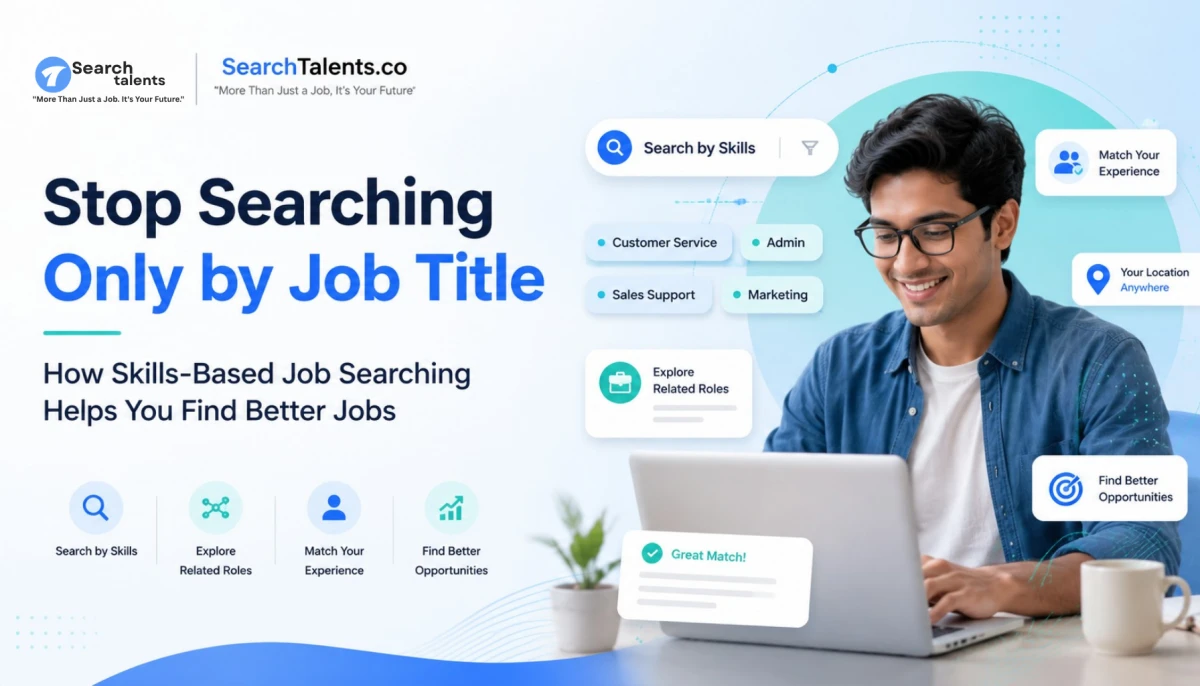
Finding the right job is not always about typing one job title into a search bar and applying to everything that appears.
Many jobseekers limit themselves without realising it.
Someone with customer service experience may search only for “Customer Service Officer.” A marketing graduate may search only for “Marketing Assistant.” An experienced hospitality worker might keep looking only for the exact title they held in their previous job.
But employers often use different titles for roles that require very similar skills.
A better approach is to search by a combination of skills, job titles, industries and locations. SearchTalents is designed around this type of job discovery, allowing candidates to search opportunities using skills or job titles and location while building profiles around their experience and career goals.
Here is how a broader, skills-based job search can help you discover opportunities you may otherwise miss.
The Same Job Can Have Several Different Titles
Job titles are not standardised across every company.
Two employers may advertise very similar positions under completely different names.
For example, someone looking for administrative work might find vacancies advertised as:
Administration Officer
Office Assistant
Administrative Assistant
Receptionist
Office Coordinator
Business Support Officer
Operations Assistant
The responsibilities may overlap significantly even though the titles are different.
If you search for only one title, you could miss several roles that actually match your capabilities.
Before starting your job search, write down five to ten alternative job titles related to the work you want.
This immediately increases the range of opportunities you can explore without forcing you to apply for irrelevant positions.
Start With Your Skills, Not Only Your Previous Job Title
Your previous job title tells only part of your professional story.
Your skills often reveal a much wider range of career opportunities.
Imagine you have worked as a retail sales assistant.
You may already have experience in:
Customer service
Cash handling
Stock management
Sales
Complaint resolution
Product knowledge
Teamwork
Point-of-sale systems
Those skills could potentially be relevant to jobs in customer service, administration, sales support, reception, account support or other service-based positions.
Instead of asking:
“What jobs have the same title as my previous job?”
Ask:
“Which jobs need the skills I already have?”
That question can completely change your job search.
Read Responsibilities Before Deciding a Job Is Not for You
Sometimes jobseekers reject an opportunity simply because the title sounds unfamiliar.
That can be a mistake.
Before deciding whether a vacancy is relevant, read the actual responsibilities.
For example, a position called Client Services Coordinator might involve:
Answering customer enquiries
Updating records
Scheduling appointments
Preparing reports
Coordinating with internal teams
A candidate with administration and customer service experience may already have many of those skills despite never holding the title “Client Services Coordinator.”
Focus on what the employee will actually do each day, not just what the employer calls the position.
Identify Your Transferable Skills
Transferable skills are abilities that can be useful across different jobs and industries.
They become especially valuable when you are:
Changing careers
Looking for your first professional job
Returning to work
Moving into a new industry
Applying with limited direct experience
Common transferable skills include communication, teamwork, organisation, time management, problem-solving and customer service.
Technical skills can also transfer.
For example, someone who regularly uses Excel for inventory management may be able to use that capability in an administration, finance support or operations role.
The goal is to identify where your existing experience overlaps with the requirements of another position.
Search Using More Than One Keyword
Using different search terms can uncover different vacancies.
Suppose you want marketing work.
Instead of searching only:
Marketing Assistant
try related searches such as:
Marketing Coordinator Digital Marketing Social Media Content Marketing Marketing Executive Communications Assistant
You can also search for skills instead of job titles:
SEO Google Ads Content Writing Social Media Management
SearchTalents allows jobseekers to search using skills or job titles and location, so experimenting with related keywords can help surface different opportunities.
Do not use dozens of unrelated keywords. Keep your searches connected to your genuine skills and career direction.
Use Location as Part of Your Strategy
Job searching is also about geography.
If you search only one suburb, you may miss suitable vacancies in nearby areas.
Think about how far you are realistically willing and able to travel.
Consider:
Nearby suburbs
Public transport options
Driving distance
Hybrid opportunities
Relocation possibilities, where appropriate
SearchTalents currently features job opportunities across multiple Australian locations and industries, rather than focusing on a single occupation or region.
A slightly broader location search can therefore reveal roles you would not see with an overly narrow search.
Compare Your Skills With the Job Description
Once you find an interesting vacancy, do not immediately click Apply.
First compare your background with the advertisement.
Look for three categories:
Skills you already have
These should be clearly demonstrated in your resume.
Skills you partly have
Perhaps you have used similar software, completed related coursework or performed a comparable task.
Skills you do not have
Decide whether they are mandatory requirements or skills that could reasonably be learned after joining.
You do not need to match every sentence in a job description.
However, you should understand where you are a strong match and where there are gaps before submitting your application.
Update Your Profile When Your Skills Change
Your jobseeker profile should not remain unchanged for years.
Update it when you:
Complete a qualification
Gain a certification
Start or finish a job
Learn new software
Complete an internship
Finish an important project
Change the type of work you are targeting
This matters because SearchTalents uses information such as skills and experience to help connect candidate profiles with relevant opportunities.
An outdated profile may no longer represent the jobs you are capable of doing.
Even small updates can make your professional direction clearer.
Do Not Apply to Every Related Job
A broader job search does not mean applying randomly.
The purpose is to discover more relevant opportunities, not increase your application count for the sake of it.
Before applying, check:
Main responsibilities
Required skills
Experience level
Employment type
Location
Salary information, if available
Qualifications
Any mandatory licences or certifications
If the job is reasonably aligned with your experience and career goals, consider applying.
If there is almost no connection, move on.
Five targeted applications can be more useful than dozens of applications sent without reading the requirements.
Let Your Resume Reflect the Role You Want Next
Your resume should not only describe where you have been.
It should also help employers understand where you can go next.
Suppose your previous title was Retail Team Member, but you are applying for customer support positions.
Your resume should highlight experience such as:
Responding to customer enquiries
Resolving complaints
Processing transactions
Maintaining accurate customer information
Working with team members during busy periods
These responsibilities make the connection between your retail background and a customer support role much clearer.
Never change your actual job title or invent responsibilities.
Instead, emphasise the genuine parts of your experience that are relevant to the position you are targeting.
Use Job Searching to Learn What Employers Want
Every job advertisement contains useful information, even when you do not apply.
After reviewing 15–20 vacancies in your target area, patterns will begin to appear.
You might repeatedly see employers requesting:
Excel
CRM software
Customer communication
Reporting
Specific licences
Industry knowledge
Project coordination
Digital tools
Write down the requirements that appear most often.
If one skill keeps appearing and you do not have it, that gives you a clear development goal.
Instead of randomly completing courses, you can build skills based on what employers in your target roles are actually requesting.
Build a Job Search Around Possibilities, Not Labels
Your next opportunity may not have the exact job title you expected.
That is why effective job searching requires flexibility.
Your education, work history, projects and skills may qualify you for more roles than you realise.
Search by different titles. Explore related industries. Read responsibilities carefully. Compare the requirements with your actual abilities and keep your professional profile current.
SearchTalents connects jobseekers and employers across multiple Australian industries and provides job discovery and application features through its online platform.
Final Thoughts
A narrow job search can create the impression that there are very few opportunities available.
Sometimes the problem is not that relevant jobs do not exist.
It is simply that you are searching for them under one title.
Start thinking in terms of skills, responsibilities and related roles.
Instead of asking:
“Where can I find another job with my exact previous title?”
ask:
“Where else could my skills create value?”
That shift can help you discover roles you may never have considered, create more targeted applications and build a job search around what you can actually contribute.
Ready to explore your next opportunity?
Create or update your profile on SearchTalents.co, search jobs using your skills, preferred job titles and location, and explore opportunities that match the direction you want your career to take.
Australian Government guidance on tailoring a resume and highlighting job-specific and transferable skills gained through work, study, hobbies or volunteering.
4. Workforce Australia – How to Write a Great Profile
A skills-based job search focuses on the abilities you can offer rather than searching only by one job title. It can help you discover roles with similar responsibilities across different industries.
Different employers often use different titles for similar roles. Searching by skills can uncover opportunities that may not appear when you use only one specific job title.
Use skills that regularly appear in your target roles, such as customer service, Excel, administration, sales, digital marketing, project coordination or specific technical skills.
Review job descriptions with similar responsibilities and note the different titles employers use. You can then include those titles in future searches.
Yes. Skills such as communication, organisation, teamwork, customer service and problem-solving can apply across many industries and occupations.
Yes, if the responsibilities and required skills closely match your experience. Focus on what the job involves rather than relying only on the title.
Update it whenever you gain new skills, qualifications, certifications, projects or work experience. Keeping your profile current can make your career direction clearer to employers.
Relevant applications are usually more useful. Focus on roles where your skills, experience and career goals reasonably match the employer’s requirements.
SearchTalents can help jobseekers explore opportunities using skills, job titles and location, making it easier to discover roles beyond one narrow search term.