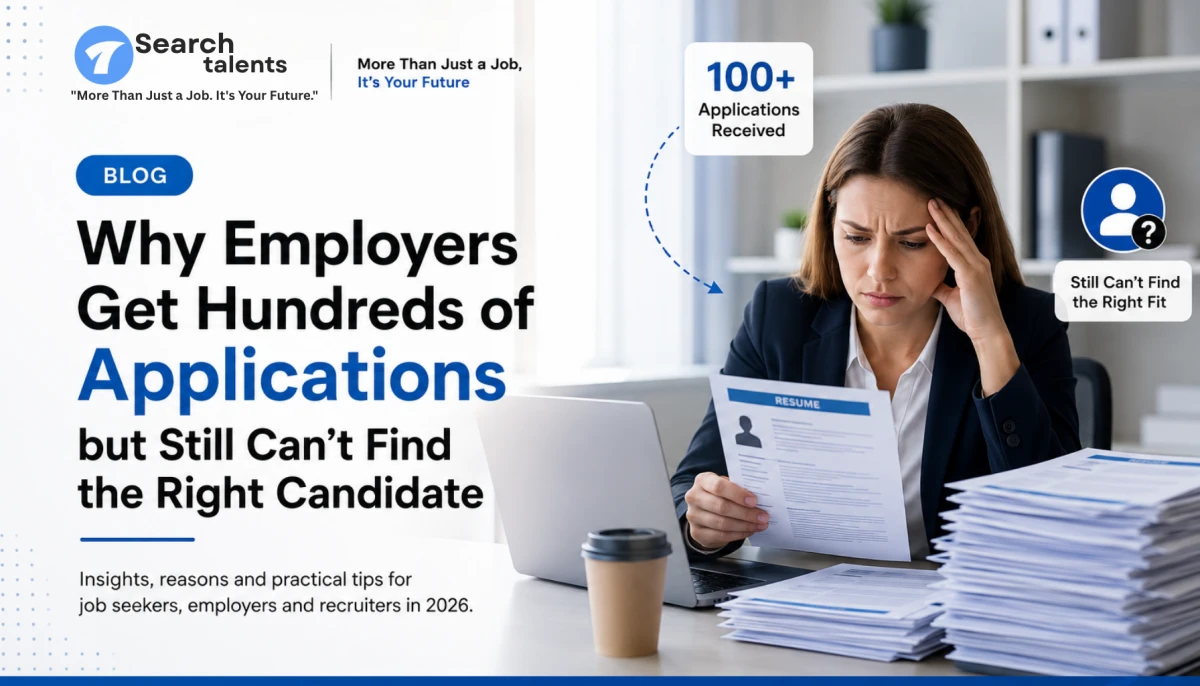
Hiring should be simple: advertise a position, receive applications, interview the strongest candidates and hire the best person.
But in 2026, many employers are experiencing something very different.
A single vacancy can attract dozens—or even hundreds—of applications, yet recruiters may still struggle to find candidates who genuinely match the role.
At the same time, job seekers are asking an equally frustrating question:
“If companies are hiring, why am I not getting interviews?”
This creates one of the biggest contradictions in the modern job market. Employers say they cannot find the right people, while qualified candidates say they cannot get noticed.
The real problem is often not the number of candidates or the number of available jobs.
It is the quality of the match between them.
Here is why this hiring gap exists—and what both job seekers and employers can do about it.
1. More Applications Do Not Automatically Mean Better Candidates
Receiving 300 applications may sound better than receiving 30, but application volume alone does not improve hiring.
Many job seekers apply broadly because online applications are fast and convenient. As a result, employers may receive applications from people who:
Do not meet essential requirements
Have unrelated experience
Are applying to almost every available position
Have not read the complete job description
Are looking for a different salary or work arrangement
Do not have required licences or qualifications
Are located outside the practical working area
Recruiters then have to spend more time identifying the small percentage of applicants who are genuinely suitable.
For employers, the goal should therefore be better applications—not simply more applications.
2. Job Seekers Are Applying Too Broadly
Applying for more jobs can feel productive.
But sending the same resume to 50 unrelated positions rarely creates better results.
A marketing candidate applying for marketing coordinator, sales manager, customer service, administration and HR positions with exactly the same resume may appear unfocused.
A better strategy is to identify a specific group of roles that match your skills and experience.
Before applying, ask:
Does my experience match the main responsibilities?
Do I meet the essential requirements?
Can I demonstrate the skills requested?
Is the salary and location suitable?
Can an employer quickly understand why I fit this role?
Ten carefully selected applications can be more valuable than dozens of random ones.
3. Employers Are Sometimes Searching for a “Perfect” Candidate
Candidates are not the only side contributing to the problem.
Some job advertisements contain unrealistic combinations of requirements.
An employer may request several years of experience, multiple technical skills, industry knowledge, leadership ability, advanced qualifications and specialist software knowledge—even when only some of those requirements are genuinely essential.
This can reduce the available talent pool.
Instead, employers should separate requirements into two groups:
Must-have
Skills or qualifications necessary from the first day.
Nice-to-have
Skills that would be useful but could realistically be learned after joining.
Someone who meets 80% of the requirements and has strong learning ability may ultimately outperform someone who looks perfect on paper.
4. Generic Resumes Make Strong Candidates Look Average
A candidate can have excellent experience and still appear unsuitable if their resume does not clearly connect that experience to the position.
Consider these two descriptions.
Generic:
“Responsible for customer service and administration.”
Stronger:
“Managed daily customer enquiries, maintained client records and supported administrative operations in a high-volume service environment.”
The second version gives recruiters much more context.
Strong candidates should make it easy for employers to identify:
What they can do
What tools they have used
Which industries they understand
What responsibilities they have handled
What results they have achieved
Your resume should not make a recruiter search for your value.
It should make that value obvious.
5. Job Titles Can Hide Transferable Skills
Another reason employers miss good candidates is excessive focus on previous job titles.
A candidate may never have worked under the exact title being advertised but could already possess most of the required abilities.
For example, someone moving from hospitality into customer service may already have experience with:
Customer communication
Complaints handling
Teamwork
Time management
Payment processing
Problem-solving
Working under pressure
Similarly, an administrative professional may have transferable skills suitable for recruitment coordination, operations, customer support or office management.
Employers who look beyond job titles can uncover a much larger talent pool.
Job seekers should also explain transferable skills clearly rather than expecting recruiters to make the connection themselves.
6. AI Has Made Applying Easier—but Standing Out Harder
AI tools can help candidates improve grammar, organise resumes, prepare interview answers and understand job descriptions.
But there is a downside.
When hundreds of candidates use similar tools and templates, applications can begin to sound almost identical.
Statements such as:
“Results-driven professional with excellent communication and teamwork skills”
tell an employer very little without supporting evidence.
Candidates should use technology to improve their application—not remove their personality and real experience from it.
Instead of simply claiming a skill, provide evidence.
For example:
Instead of: “Excellent problem-solving skills.”
Try: “Resolved customer order issues by coordinating between clients, warehouse staff and delivery teams.”
Specific examples create credibility.
7. Employers May Be Screening Out Potential Too Early
Recruitment filters are useful, especially when hundreds of people apply.
But overly rigid screening can eliminate candidates who could become excellent employees.
An applicant may be rejected because they:
Have slightly fewer years of experience
Come from another industry
Have a non-traditional career path
Recently completed training
Took a career break
Use a different job title
Lack one non-essential software skill
Recruitment should identify capability, not simply search for identical career histories.
Structured interviews, practical questions and skills assessments can reveal qualities that a resume alone may miss.
8. Candidates Often Describe Duties Instead of Achievements
Many resumes read like job descriptions.
They explain what the employee was expected to do but not how effectively they did it.
For example:
Duty: “Managed social media accounts.”
Achievement-focused: “Planned and published weekly social media content while monitoring engagement and campaign performance.”
Whenever possible, candidates should show outcomes using:
Numbers
Percentages
Time saved
Customers assisted
Projects completed
Revenue supported
Processes improved
Teams managed
Evidence makes your experience easier to evaluate.
9. Poor Job Advertisements Attract Poor Matches
Job advertisements also influence candidate quality.
A vague advertisement such as:
“We are looking for a motivated team player to join our growing organisation.”
does not tell candidates enough.
A useful advertisement should clearly explain:
Job title
Main responsibilities
Required experience
Essential skills
Employment type
Location
Work arrangement
Qualifications
Salary range where appropriate
Application process
Career opportunities
Clear advertisements help unsuitable candidates self-select out while encouraging appropriate candidates to apply.
That saves time on both sides.
10. Speed Has Become Part of Recruitment
A strong candidate may be interviewing with several employers at the same time.
If one business takes weeks to respond while another communicates quickly, the slower company may lose that candidate.
Employers do not need to make rushed decisions, but they should keep applicants informed.
Even a simple update such as:
“Your application is still under review and we expect to provide an update next week”
creates a better candidate experience than complete silence.
Job seekers should follow the same principle.
Respond promptly to interview invitations, recruiter messages and requests for documents.
Good hiring depends on communication from both sides.
11. Job Seekers Need Visibility, Not Just Applications
Searching for jobs is only one part of building a career.
Candidates should also make themselves easier for recruiters and employers to discover.
A stronger professional presence can include:
An updated job seeker profile
Clear career preferences
Relevant skills
Current work experience
Certifications
Portfolio or project examples
Accurate contact information
A focused professional summary
Think of your professional profile as another route into the job market.
Instead of always searching for employers, create opportunities for employers to discover you.
12. Better Matching Is the Real Future of Hiring
The future of recruitment is unlikely to be about generating even more applications.
Employers already have access to huge numbers of candidates.
The bigger challenge is connecting the right person with the right opportunity at the right time.
Job seekers need to become more targeted.
Employers need to become more realistic.
Recruiters need better ways to identify relevant skills.
And job platforms need to make discovery and matching easier.
This is where platforms such as SearchTalents.co can help create a more focused connection between people looking for opportunities and organisations looking for talent.
Instead of treating recruitment as a numbers game, both sides should focus on relevance.
What Job Seekers Should Do Now
If you are searching for a new role:
Define the jobs you genuinely want
Apply to positions matching your skills
Tailor your resume to each opportunity
Highlight achievements and transferable skills
Keep your professional profile complete
Add relevant skills and certifications
Research employers before interviews
Respond quickly to recruiter communication
Continue developing practical workplace skills
The objective is not to become visible to every employer.
It is to become highly relevant to the right employer.
What Employers Should Do Now
If you are recruiting:
Write clear job advertisements
Remove unnecessary requirements
Separate essential and preferred skills
Consider transferable experience
Evaluate ability as well as job titles
Keep candidates updated
Simplify unnecessary recruitment stages
Interview promising candidates quickly
Consider candidates who can grow into the role
Hiring becomes easier when businesses stop searching for an imaginary perfect candidate and start identifying people with the ability to succeed.
Final Thoughts
The modern hiring problem is not simply a shortage of jobs or candidates.
It is a matching problem.
Job seekers are competing for attention while employers are trying to identify relevant talent inside increasingly large applicant pools.
That means applying more is not always the answer.
Receiving more applications is not always the answer either.
Better targeting, clearer information, stronger profiles and smarter matching are.
For job seekers, the message is simple: show employers clearly where you can add value.
For employers, look beyond perfect resumes and focus on genuine capability.
The organisations and candidates that understand this shift will be better positioned to succeed in the changing job market.
Looking for your next opportunity—or the right person for your team? Explore SearchTalents.co and make your next search more relevant.
This topic should work particularly well on LinkedIn because the “hundreds of applications but still can’t hire” contradiction gives you a stronger discussion hook than another generic resume or interview article. It also lets you target job seekers + employers + recruiters with one post.
Sources & References
Jobs and Skills Australia – Recruitment Experiences and Outlook Survey Useful for employer recruitment activity, hiring difficulty and staffing outlook in Australia. Recruitment Experiences and Outlook Survey
Jobs and Skills Australia – Internet Vacancy Index Tracks online job advertisements and labour demand across occupations, skill levels and regions. Internet Vacancy Index
Jobs and Skills Australia – Australian Jobs 2026 Current Australian labour-market information covering occupations, industries, workforce skills and career pathways. Australian Jobs 2026
Australian Bureau of Statistics – Labour Force, Australia Official employment, unemployment, participation and labour-force data for Australia. Labour Force Australia
Jobs and Skills Australia – Occupation Shortage Useful for understanding skills shortages, suitability gaps, retention issues and areas where employers struggle to recruit. Occupation Shortage Data
Jobs and Skills Australia – Occupation Mobility Shows how transferable skills and movement between occupations can broaden opportunities for workers and employers. Occupation Mobility Interactive Tool
Many candidates apply without fully checking the job requirements, experience level, location or essential skills. This increases application volume but not necessarily candidate quality.
Not always. A smaller number of targeted applications with a tailored resume can often produce better results than sending the same application everywhere.
Use a clear resume, highlight relevant achievements, match your skills to the role and make your experience easy for recruiters to understand.
No. Candidates who meet the key requirements and show strong learning potential can still become excellent employees, even if they lack some preferred skills.
Transferable skills help employers identify capable candidates from different industries or job backgrounds who may still perform strongly in the advertised role.
Yes. Overly rigid filters based on job titles, years of experience or minor skill gaps can eliminate people who may be highly suitable.
A strong match happens when the candidate’s skills, experience, expectations and career goals align closely with the role and workplace.
Clear responsibilities, requirements, salary expectations and work arrangements help suitable candidates apply while reducing irrelevant applications.
SearchTalents can help job seekers and employers connect more effectively by improving candidate visibility and making the search for relevant opportunities more focused.