
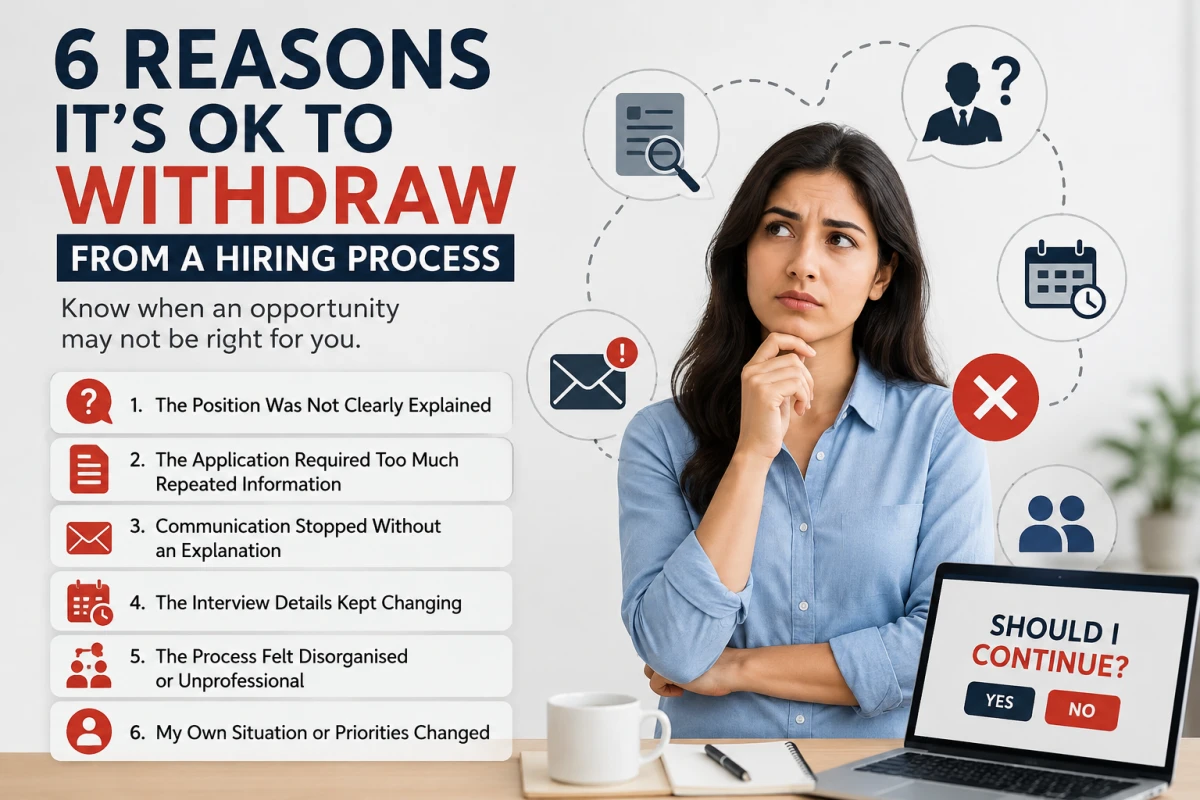
When I started searching for work, I believed that every application had to be taken as far as possible. If an employer contacted me, I felt that I should accept the interview, complete every assessment and continue with the process until the company made its decision.
Over time, I realised that recruitment is not only about an employer deciding whether a candidate is suitable. Job seekers also need to decide whether the position and organisation are right for them.
Withdrawing from a hiring process does not always mean that a candidate is impatient, unprofessional or no longer interested in working. Sometimes the information provided during recruitment reveals that the opportunity is different from what was originally advertised. At other times, poor communication or an unnecessarily complicated process creates concerns about how the organisation treats its employees.
Here are six situations that taught me when it may be reasonable to reconsider an opportunity before attending the interview.
A clear job advertisement helps me understand whether my skills, experience and career goals match the position. Unfortunately, some advertisements provide only a job title and a short list of general duties.
Statements such as “support the team,” “manage different responsibilities” or “complete other duties as required” do not explain what an ordinary working day will involve. Important details such as the work location, employment type, expected hours, salary range and reporting structure may also be missing.
When I see an interesting but incomplete advertisement, I do not immediately reject it. I first try to learn more by checking the company’s website or asking the recruiter for clarification.
However, I become concerned when the recruiter cannot provide simple information about the position. If the responsibilities change during different conversations or the actual role sounds completely different from the advertisement, I may decide not to continue.
A job title alone is not enough for me to evaluate an opportunity. I need to understand what I will be doing, what the employer expects and whether I can genuinely contribute.
I understand that employers need information to assess candidates. Contact details, employment history, qualifications, availability and work rights can all be relevant during recruitment.
The process becomes frustrating when I upload my resume and then have to manually enter every detail again. Some applications include several pages of questions before explaining anything meaningful about the role.
A long form does not always mean that an employer has a thorough recruitment process. Sometimes it simply means that the application system has not been designed with candidates in mind.
Before spending a significant amount of time on an application, I now consider:
I am willing to make an effort for a relevant opportunity, but I also need to protect my time and personal information. If the application feels unnecessarily repetitive or requests sensitive details too early, I may leave without completing it.
Job searching requires patience. Employers may receive many applications, and reviewing them properly can take time. I do not expect an immediate decision after every application.
However, there is a difference between a reasonable delay and complete silence.
A simple confirmation email tells me that my application was received. If I am shortlisted, a clear message about the next stage helps me prepare. Even when the process is delayed, a brief update can maintain trust.
I become uncertain when an employer contacts me urgently, asks for my availability and then disappears. The same concern arises when an interview is promised but never scheduled, or when repeated follow-up messages receive no response.
Poor communication may not always reflect the entire workplace. Recruiters can become busy, hiring priorities can change and positions can be placed on hold. Still, communication during recruitment gives candidates an early impression of the organisation.
If an employer cannot confirm whether the position is still available or explain what happens next, I may focus my energy on opportunities where communication is clearer and more respectful.
I understand that interviews sometimes need to be rescheduled. Unexpected meetings, staff absences and operational problems can affect even well-organised employers.
One change is usually not a problem. Repeated changes without proper notice are different.
An employer may move the interview several times, change it from online to onsite at the last minute or invite additional interviewers without explaining their roles. In some cases, candidates are given different information about the salary, working hours or responsibilities during each conversation.
These changes create confusion and make it difficult to prepare properly.
Before attending an interview, I want to know:
Clear instructions show that the organisation respects the candidate’s time. If the process remains disorganised and important details keep changing, I may reconsider whether the opportunity is right for me.
A short, role-related assessment can help candidates demonstrate their abilities. It can be especially useful for people who have practical skills but limited formal experience.
I am comfortable completing a reasonable task when its purpose, expected completion time and evaluation method are explained. The concern begins when an employer requests a large project before conducting a proper interview.
For example, a candidate may be asked to prepare a complete marketing campaign, design multiple finished materials, develop a working software feature or create a detailed business strategy. These tasks can take many hours and may produce work the organisation could use commercially.
Before completing an assessment, I consider whether it is:
When a task feels excessive, I ask whether a shorter alternative, portfolio sample or previous work example would be acceptable. If the employer refuses to discuss the scope or expects substantial unpaid work from every applicant, I may withdraw.
My willingness to work hard should not require me to ignore the value of my time and skills.
Candidates often focus so heavily on giving the right answers that they forget to observe what is happening around them.
During early conversations, I pay attention to how the recruiter speaks about the company, the team and the person who previously held the position. I also notice whether they answer reasonable questions openly.
Certain behaviours can create concerns, including:
One warning sign may have a reasonable explanation. I try not to make a decision based on a single awkward conversation. Instead, I look for patterns and ask clear questions.
If the answers continue to make me uncomfortable, withdrawing may be better than accepting a position that does not meet my needs or expectations.
I do not leave a recruitment process without thinking carefully. First, I review the original advertisement and compare it with the information later provided. I then decide whether the concern can be resolved through a polite question.
When clarification does not resolve the issue, I send a short and professional message. I thank the employer for considering my application, explain that I am withdrawing and wish them well with their search.
I do not need to provide a long complaint or criticise the organisation. A respectful message protects my professional reputation and gives the employer a clear answer.
I also keep searching instead of waiting for one application to succeed. Platforms such as SearchTalents.co allow job seekers to explore different vacancies, review requirements and apply for opportunities that match their skills and goals.
Withdrawing from a hiring process is not always an easy decision, especially when employment opportunities feel limited. However, accepting every interview without evaluating the position is not necessarily the best approach.
Job seekers should remain flexible, patient and professional, but they should also pay attention to unclear information, excessive demands, poor communication and unexpected changes.
A suitable opportunity should allow both the employer and candidate to make an informed decision. Employers deserve candidates who are genuinely interested in the position, and job seekers deserve clear information and respectful treatment throughout recruitment.
Searching for work is not only about finding any available job. It is about finding an opportunity where my skills are valued, the expectations are understood and I can build a stable and positive future.