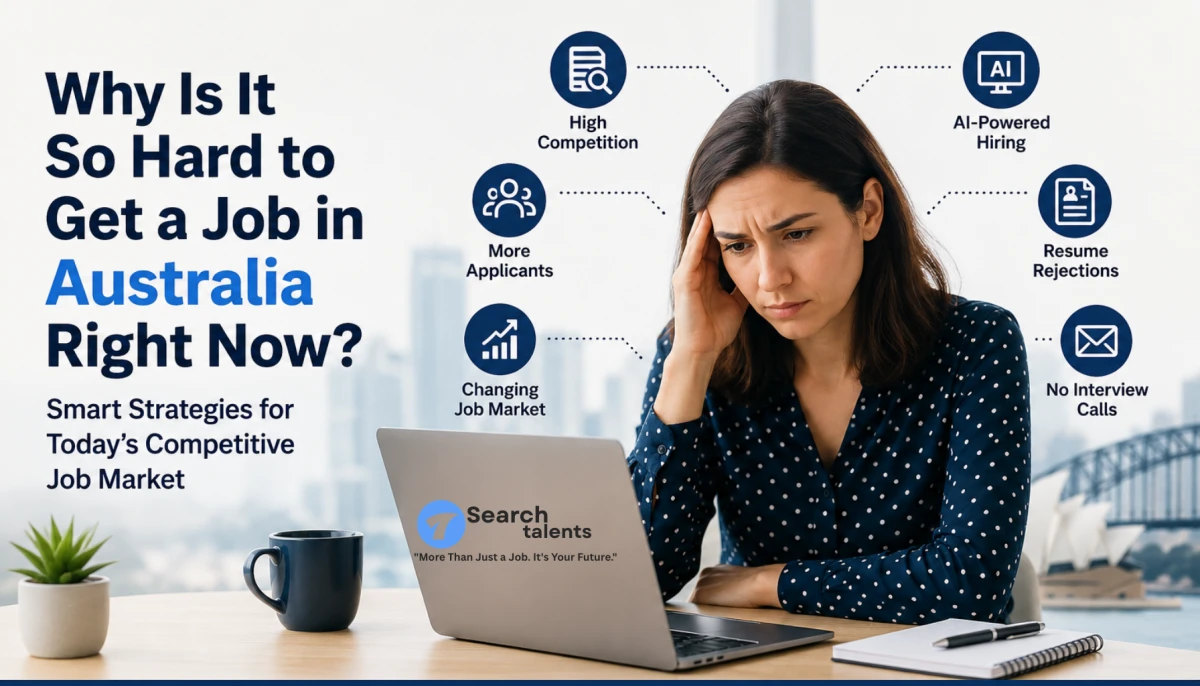
You apply for job after job, update your resume and wait for a response—but nothing happens.
For many job seekers in Australia, this experience has become common. Even candidates with qualifications, work experience and useful skills are finding it difficult to secure interviews.
This does not mean there are no jobs available. Employers are still recruiting, but competition has increased and hiring processes have become more selective. A general resume and hundreds of random applications may no longer be enough.
To improve your chances, you need a focused job-search strategy that clearly shows employers why you are suitable for their role.
Search and apply for the latest jobs across Australia
https://searchtalents.co/search-jobs
The Australian job market is constantly changing. Some industries are growing, while others are hiring more carefully. Employers may also receive a large number of applications for a single position.
This allows recruiters to compare more candidates and choose applicants who closely match the job requirements.
Many companies are looking for candidates who can:
Candidates who do not explain these abilities clearly in their applications may be overlooked—even when they have the right potential.
Explore more career advice and job-search guides
https://searchtalents.co/blog/category/jobseekers
Using one resume for every application is one of the most common job-search mistakes.
Each employer has different requirements. A resume prepared for an administration role may not be suitable for a customer service, sales or reception position.
Before applying, carefully review the job advertisement and update the following sections:
Your resume should clearly answer one question:
Why are you suitable for this specific role?
You do not need to rewrite your entire resume every time. However, the most important information should match the position you are applying for.
Applying for every available job may feel productive, but it can reduce the quality of your applications.
For example, applying for warehouse, marketing, accounting, hospitality and administration roles with the same resume creates an unclear professional profile.
Instead, choose two or three related job titles based on your skills and experience.
For example:
These positions require similar skills, making it easier to prepare a strong resume and LinkedIn profile.
A focused job search helps employers understand your career direction.
Many resumes only explain what the candidate was responsible for.
For example:
Responsible for customer service and answering enquiries.
This sentence does not show the value the candidate provided.
Learn why applying everywhere may not bring job results
https://searchtalents.co/blog/applied-everywhere-but-still-no-job-heres-what-you-need-to-change
A stronger version would be:
Assisted more than 40 customers each day and resolved enquiries professionally to maintain a positive customer experience.
Whenever possible, include:
Achievements make your experience more specific and credible.
Recruiters often search for candidates using skills, job titles, qualifications and industry-related terms.
If the job advertisement mentions specific skills, your resume should include those terms when they genuinely match your experience.
For an administration role, relevant keywords may include:
Do not copy the complete job description. Instead, naturally connect your real skills and experience with the employer’s requirements.
Quickly applying without reading the full advertisement can lead to unnecessary rejection.
A role may require:
Before applying, separate the requirements into two groups:
Essential requirements: Skills or qualifications you must have.
Preferred requirements: Skills that are helpful but may not be compulsory.
Apply when you meet most of the essential requirements and can clearly demonstrate your suitability.
Job platforms are useful, but they should not be your only job-search method.
Many candidates apply through online portals and then wait. A stronger strategy includes networking, direct company research and recruiter engagement.
You can improve your visibility by:
Networking is not about asking strangers to give you a job. It is about building professional relationships and learning about opportunities.
Recruiters may review your LinkedIn profile before contacting you.
Your profile should support the information included in your resume.
Make sure it contains:
Instead of using a headline such as:
Looking for opportunities
Use something more specific:
Administrative Assistant | Customer Service | Data Entry | Office Support
This helps recruiters understand your professional value immediately.
Technology is now part of almost every industry.
You do not need to be a technical expert, but employers may expect candidates to use common digital tools confidently.
Depending on your industry, useful skills may include:
Mention the tools you have used and explain how they helped you perform your work.
Popular job advertisements may receive many applications within the first few days.
Waiting until the closing date can reduce your chances of being reviewed early.
Create job alerts using:
Check new opportunities regularly and apply as soon as you find a suitable position. However, do not sacrifice application quality simply to apply quickly.
A structured approach can help you remain focused and avoid application fatigue.
Search for suitable positions and save the best opportunities.
Tailor your resume and apply for the most relevant roles.
Update your LinkedIn profile and connect with relevant recruiters.
Follow up on previous applications and research target companies.
Review your progress and improve one career-related skill.
Keep a simple application tracker containing:
This will help you stay organised and avoid applying for the same position more than once.
Sending 100 general applications is not always better than sending 10 carefully prepared applications.
A strong application should:
Employers are not only looking for the most qualified person. They are looking for the candidate who appears most suitable for their particular workplace and role.
Finding a job in Australia can take time, especially when many candidates are competing for similar positions.
However, rejection does not always mean you lack the right skills. Your application may simply need to communicate your value more clearly.
Avoid mass applying with one general resume. Focus on relevant opportunities, improve your LinkedIn profile, highlight your achievements and build professional connections.
A targeted and consistent strategy can help you receive more responses, secure more interviews and move closer to the right opportunity.
SearchTalents.co helps job seekers discover relevant opportunities and enables employers to connect with job-ready talent.
Explore the latest jobs on SearchTalents.co and take the next step in your career.\
(1) Australian job advertisements declined slightly in June, showing increased competition across some industries.
https://www.reuters.com/world/asia-pacific/australian-job-ads-june-slip-02-mm-anz-indeed-data-shows-2026-07-06/
(2) Australia’s unemployment rate was 4.4% in May, while employment increased during the month.
https://www.abs.gov.au/statistics/labour/employment-and-unemployment/labour-force-australia/latest-release
(3) Australian employers are increasingly looking for candidates with AI and digital skills.
https://www.hiringlab.org/au/blog/2026/01/30/indeed-2026-au-jobs-hiring-trends-report/
(4) AI tools are increasingly being used to scan, score and shortlist job applications before recruiter review.
https://www.jobsandskills.gov.au/insights/ai-recruitment-becomes-norm-australia-risks-leaving-real-talent-behind-0
(5) Australian workplaces are changing as employers increase their use of AI and prioritise adaptable skills.
https://au.seek.com/career-advice/article/5-workplace-trends-to-watch